

A collection can leave your site on schedule and still leave a compliance gap if no one can show what was transferred, to whom and when. A practical waste transfer notes for businesses guide starts with documenting that handover, not simply completing a form.
If you’re unsure who prepares and signs a note, what details to include, or whether your waste needs a consignment note instead, you’re not alone. Accurate, retrievable records help make business waste movements traceable, especially when collections happen regularly or across busy London sites.
This guide explains when to use a waste transfer note, what it should record and how responsibilities are shared between the business transferring waste and the receiving party. It also covers season-ticket arrangements, records for individual transfers, retention periods and the difference between a WTN and a hazardous waste consignment note. A straightforward process for routine and one-off collections, supported by a dependable waste partner, helps you build a clearer record of each movement and support responsible handling.
Key Takeaways
- Use this waste transfer notes for businesses guide to set a clear process for documenting routine and one-off collections.
- Check that each note records the waste, transfer details and parties involved, along with the applicable classification information.
- Identify whether the waste is non-hazardous or hazardous before choosing between a waste transfer note and a consignment note.
- Keep collection records organised with related site logs or internal waste registers so each movement is easier to trace.
- Assess a waste partner’s communication and check relevant carrier details to support a dependable record trail.
Waste transfer notes for businesses: what they are and when you need one
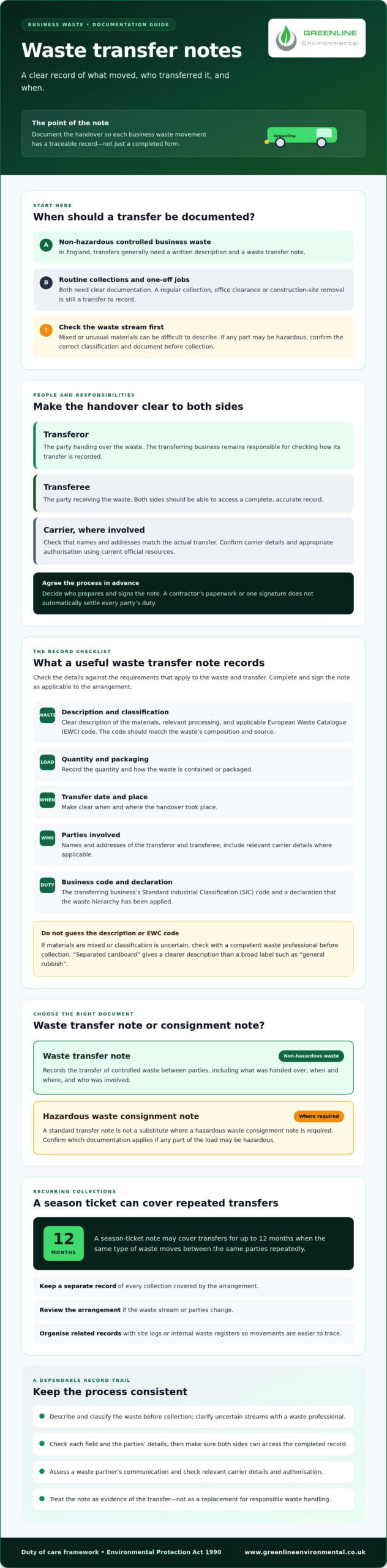
A waste transfer note records the transfer of controlled waste between parties. For non-hazardous business waste, it provides a written account of what was handed over, when and where the transfer took place, and who was involved.
This record links a collection to clear evidence. For regular collections, consistent notes make it easier to check that the waste description and parties’ details remain accurate. A one-off clearance needs the same care: a single collection from an office or construction site is still a transfer that should be documented.
The requirement sits within the duty of care framework under the Environmental Protection Act 1990. A waste transfer note can help demonstrate that waste was handled responsibly, but it does not remove the responsibilities of the parties involved. Hiring a contractor to collect waste does not mean the business that produced it can stop checking how the transfer is recorded. This waste transfer notes for businesses guide focuses on a traceable process, not treating paperwork as a substitute for responsible handling.
Which business waste transfers need documenting?
In England, transfers of non-hazardous controlled waste from businesses generally need a written description and a waste transfer note. This applies to planned, recurring collections and one-off jobs. For example, a business might arrange routine collections from its premises and a separate office clearance or construction-site removal. Document each transfer clearly, even when the collection arrangements differ.
Check the waste stream before booking a collection. Unusual or mixed materials can be difficult to describe accurately, and different rules may apply if any waste is hazardous. If you’re unsure how to classify a stream or which document applies, clarify this with the relevant waste professional before collection.
Who is involved in a waste transfer note?
Responsibilities depend on the parties and circumstances, so don’t assume one signature or a contractor’s paperwork settles every duty. Agree in advance who will prepare and sign the note, and make sure both sides can access a complete record. For businesses arranging commercial trade waste collections, an agreed process helps keep movements traceable across busy premises and multiple locations.
What information should a business waste transfer note include?
A useful note identifies the waste and makes the handover clear to anyone reviewing the record later. GOV.UK’s official government guidance sets out the information businesses need to record. Check the details against the requirements that apply to your waste and transfer.
Core record fields include the waste description and applicable European Waste Catalogue (EWC) code, quantity and how it is contained or packaged, transfer date and place, both parties’ names and addresses, the transferring business’s Standard Industrial Classification (SIC) code, and a declaration that the waste hierarchy has been applied.
Describe and classify the waste accurately
A description such as “general rubbish” may be too broad to show what was transferred. Name the materials and relevant waste stream, and describe their condition or any processing where this helps clarify the load. For example, “separated cardboard” is more informative than a general label that could cover mixed materials.
The EWC code helps classify the waste, but it must match the waste’s composition and source. Don’t guess if materials are mixed or their classification is uncertain. Pause and check the correct description and code with a competent waste professional before collection. If any part of a load may be hazardous, confirm which documentation applies. A standard transfer note is not a substitute for a hazardous waste consignment note where one is required.
Checklist: details to confirm on the note
- Waste: a clear description, any relevant processing, and the applicable EWC code.
- Load: quantity and how it is contained or packaged.
- Handover: place and date of transfer.
- Parties: names and addresses of the transferor and transferee.
- Business and declaration: the transferor’s SIC code and the required waste-hierarchy statement.
Check each field before signing. The transferor and transferee should complete and sign the note as applicable to the arrangement, and both should retain an accurate record. The waste-hierarchy declaration records that the hierarchy has been applied; it should not be treated as a box to tick without considering the waste management choice.
Recurring collections and season tickets
Where the same type of waste moves between the same parties repeatedly, a season-ticket note may cover transfers for up to 12 months. Keep a separate record of every collection, and review the arrangement if the waste stream or parties change. This waste transfer notes for businesses guide is a starting point; check current official requirements if a transfer falls outside your usual process.
Waste transfer note or consignment note: which document applies?
The right document depends on the waste, not simply on the type of collection. A waste transfer note is generally used to record a transfer of non-hazardous controlled waste. In England, hazardous waste movements generally require a hazardous waste consignment note and follow separate procedures. A transfer note is not suitable for every waste type or circumstance.
| Document | Generally applies to | What to check |
|---|---|---|
| Waste transfer note (WTN) | Transfers of non-hazardous business waste | That the waste description, parties and transfer details are accurate. |
| Hazardous waste consignment note (HWCN) | Movements of waste classified as hazardous | Classification, required consignment information and applicable procedures. |
This is a practical distinction, not a classification decision. Check the current Waste Duty of Care Code of Practice and relevant official guidance, and seek competent advice if the waste’s status is unclear.
How hazardous waste changes the paperwork
A consignment note records a hazardous waste movement through the relevant stages, from the party sending it to the carrier and receiving site. Its information and steps differ from those for a routine WTN, so confirm who must complete each part and which procedures apply before collection. Don’t rely on a familiar description or an old note if the contents have changed.
Common documentation mistakes to avoid
Small discrepancies can make a record trail difficult to rely on. Before a collection, check that the description reflects the actual waste, the quantity is consistent with the load, and the parties’ details are complete. Don’t copy a previous note without checking whether the waste, collection site, carrier or receiving party has changed.
If the paperwork and collection record don’t match, raise the discrepancy promptly with the relevant parties. Keep the corrected record and a clear account of what was amended; don’t overwrite information in a way that obscures its history. A dependable process supports traceability, but it doesn’t remove each party’s responsibilities. If you’re arranging a commercial collection, you can discuss your waste collection requirements and confirm service suitability before proceeding.
How to organise waste transfer notes across regular and one-off collections
A consistent workflow helps facilities teams connect each collection to a record they can find and check later. Whether waste leaves a busy London premises on a regular schedule or during a one-off clearance, use the same core steps:
- Identify the waste. Confirm the waste stream and describe what is actually being collected. If the materials or their classification have changed, review the documentation before collection.
- Check the receiving party. Confirm the details of the parties involved and check relevant carrier information through current official resources.
- Document the transfer. Complete the appropriate note with the collection details, and make sure the record reflects the actual handover.
- File and reconcile it. Save the note promptly, then match it to the collection record, site log or internal waste register. Use invoices as a cross-check, not as a replacement for transfer documentation.
This routine gives each transfer a clear place in your records. It works best when site teams can follow it in practice, including when access is restricted or collections need to fit around business activity. For premises in EC1, EC2, EC3, EC4, WC1, WC2, E1, SE1, SW1, SW8, SW7 and SW3, record the specific collection site so movements across London locations are easy to distinguish.
Managing regular collections and repeat transfers
For recurring commercial trade waste collection, assign someone to check that the note still matches the waste stream, parties and collection arrangement. A season-ticket note may cover repeated transfers of the same waste between the same parties for up to 12 months, but keep a separate record of each transfer. Review the arrangement if the waste description or parties change, rather than carrying forward outdated details.
For one-off collections, such as an office clearance or construction-site removal, open a separate record for the job. If a business has several premises, state the site clearly so a collection from one address isn’t confused with another.
Keeping records retrievable when questions arise
Choose secure storage with access limited to staff who need it, and appoint a named record owner to oversee filing and retrieval. Use a consistent file name that includes the site, waste stream, transfer date and contractor. For example, “Site A, cardboard, transfer date, carrier” gives staff useful search terms without opening several files.
Keep related documents together or cross-reference them clearly. During an internal review or enquiry, staff should be able to move from a site log or collection entry to the matching transfer note and supporting records without relying on one person’s inbox. For multiple London locations, a shared register can show which site generated the record and who maintains it.
If you’re reviewing collection arrangements as part of this process, request a quote for your commercial waste requirements.
Choosing a waste partner and maintaining a defensible record trail
A reliable waste partner should make it easier to understand what is being collected and how the handover will be recorded. Clear communication supports your own process, but it doesn’t transfer or remove your business’s responsibilities. Before arranging a collection, use these practical checks to assess whether the provider’s process fits your needs.
Questions to ask before arranging a collection
Ask how the provider records the waste description, collection date and receiving facility details, and how you’ll receive or access supporting records. Find out how they’ll notify you if the load differs from the agreed description, a waste stream changes or a scheduled collection is missed. Check carrier details and any required authorisations using current official resources, rather than relying on verbal assurances.
For London premises, discuss the practical arrangements too. Explain access restrictions, suitable collection windows and how many locations need servicing. Confirm which site each collection relates to and how records will distinguish between them. This is particularly useful for businesses managing collections across EC1, EC2, EC3, EC4, WC1, WC2, E1, SE1, SW1, SW8, SW7 and SW3. Clear arrangements help prevent a collection being matched to the wrong location or waste stream.
Build a clear waste record process with the right support
Before appointing a provider, agree how collection records will connect with your internal register, site logs and invoices. Check that you’ll be able to retrieve the relevant paperwork if questions arise, and keep responsibility for reviewing and filing records within your own organisation. A waste contractor can support traceability, but it cannot take over every aspect of your duty of care.
Ask how the provider manages waste after collection and what information it can give you about the intended route. Greenline Environmental works with local disposal partners focused on recycling, reuse and energy recovery. These are priorities, not a promise that every material will follow a particular route; the options depend on the waste and the arrangements involved.
If a waste stream is mixed, unusual or difficult to classify, seek suitably qualified advice before collection. Specialist guidance may help clarify the description, documentation and procedure your business needs. Don’t treat a provider’s collection paperwork as a substitute for resolving uncertainty about the waste.
A dependable partner and a consistent filing process can help create a clearer record trail, from each site’s handover to its supporting documents. If you’re planning commercial collections, request a commercial waste quote from Greenline Environmental and discuss your waste streams, locations and collection requirements.
Make every waste movement easier to trace
A dependable process starts with the right document, accurate details and a record you can retrieve. Check whether a waste transfer note or consignment note applies, then match collection records to the relevant site and waste stream. A waste partner can support that process, but your business still needs to maintain clear records of its own.
This waste transfer notes for businesses guide provides a practical foundation for regular collections and one-off transfers. Greenline Environmental’s commercial waste services are available 24 hours a day, seven days a week. Its local disposal partners focus on recycling, reuse and energy recovery, supporting responsible waste management without promising a particular outcome for every material.
Ready to discuss a collection arrangement for your business? Request a commercial waste quote from Greenline Environmental. Discuss your waste streams, sites and collection needs to plan a clear process for each movement.
Frequently Asked Questions
What is a waste transfer note for a business?
A waste transfer note (WTN) records the transfer of controlled, non-hazardous waste between parties. It identifies the waste, transfer details and businesses involved, helping create a traceable collection record. For businesses in EC1, SE1 or SW1, the same basic purpose applies whether waste leaves one premises or one of several sites. A WTN supports duty-of-care evidence but doesn’t remove each party’s responsibilities.
Does every business need a waste transfer note?
Businesses generally need a WTN when transferring non-hazardous controlled waste, though the required document can depend on the waste and circumstances. Don’t assume one form suits every load: hazardous waste may need a consignment note and separate procedures. If a collection includes mixed or unfamiliar materials, check how the waste is classified and what documentation applies before arranging removal. This waste transfer notes for businesses guide can help you identify the right questions to ask.
What details should a waste transfer note include?
A WTN should record a clear waste description, the applicable European Waste Catalogue code, quantity and how the waste is contained or packaged. It should also include the transfer date and place, both parties’ names and addresses, the transferring business’s SIC code, and the relevant waste-hierarchy declaration. Check that the information matches the actual load and handover. A vague description or outdated party details can make a collection harder to trace.
How long must a business keep waste transfer notes?
For non-hazardous waste transfers in England, keep WTNs for at least two years after the transfer. Hazardous waste consignment notes have a different minimum retention period of three years. Store records so authorised staff can retrieve them, and check current official guidance for the rules that apply to your location and waste. If you operate across several sites, link each record clearly to the premises and transfer it documents.
Can a business use one waste transfer note for regular collections?
A season-ticket WTN can cover repeated transfers of the same type of waste between the same parties for up to 12 months. You must still keep a separate record of each transfer. Review the arrangement if the waste description, parties or collection details change, and don’t assume an old season ticket remains suitable after a change. Individual collection records make regular collections easier to reconcile with site logs and internal registers.
What is the difference between a waste transfer note and a consignment note?
A WTN generally documents transfers of non-hazardous controlled waste. A hazardous waste consignment note (HWCN) is used for hazardous waste movements and involves separate documentation and procedures. The correct document depends on the waste’s classification, not simply whether a collection is routine or one-off. If you’re unsure whether materials may be hazardous, confirm their classification and paperwork requirements before collection rather than relying on a standard WTN.
Who is responsible for completing a waste transfer note?
The transferor, who hands over the waste, and the transferee, who receives it, are the parties named on the WTN. The carrier may also be involved in moving the waste, depending on the arrangement. Agree who will prepare and sign the document, and check that it identifies the correct parties and transfer. Responsibilities depend on the circumstances, so don’t assume a contractor’s paperwork removes your business’s need to maintain clear records.
Can waste transfer notes be kept electronically?
Electronic filing can help staff search and organise waste records, but don’t assume a digital waste-tracking entry replaces the required WTN. As of October 2026, the digital tracking service operates alongside the existing WTN and hazardous consignment-note system, so businesses must continue completing and retaining those documents. Keep electronic copies complete, accessible and linked to the relevant collection, and check current official guidance for applicable record-keeping requirements.