

The lowest headline figure can be the least useful commercial waste quote. If one proposal covers a different collection frequency, waste volume or access arrangement, the prices are not directly comparable. Transparent commercial waste pricing starts with a clear explanation of the service behind the figure, not simply a low total.
It is understandable to want a reliable collection plan without paying for capacity or visits your business does not need. A useful quote should reflect your site, waste streams and collection requirements, with its assumptions clearly stated. This guide explains what a commercial waste quote should include, how to compare proposals on a consistent basis, and what information to provide when requesting a tailored quote. You will be better placed to assess the service scope and choose between scheduled collections, a one-off clearance or wait and load.
Key Takeaways
- Transparent commercial waste pricing makes the service scope, assumptions and billing basis clear, so you can look beyond the headline figure.
- Use consistent details about waste type, volume, collection frequency and site access to compare quotes fairly.
- Describe your waste streams, collection needs and site constraints to help shape a quote around your business.
- Consider whether scheduled collections, a one-off clearance or wait and load best fits the work you need done.
- Greenline tailors commercial waste arrangements across Central London and the South East to business needs and site logistics.
What transparent commercial waste pricing should show
A quote is useful when you can see what the proposed service includes. Transparent commercial waste pricing means a clear description of the work, the assumptions behind it and the basis on which it is billed. The headline figure alone cannot tell you whether two proposals cover the same waste, number of collections or site arrangements.
Waste management covers a range of activities, so a collection plan needs to reflect the waste being handled and how it is managed. A business arranging regular trade waste collections, for example, has different requirements from one arranging a one-off clearance. The quote should make those differences visible rather than leaving you to infer them.
What should a commercial waste quote make clear?
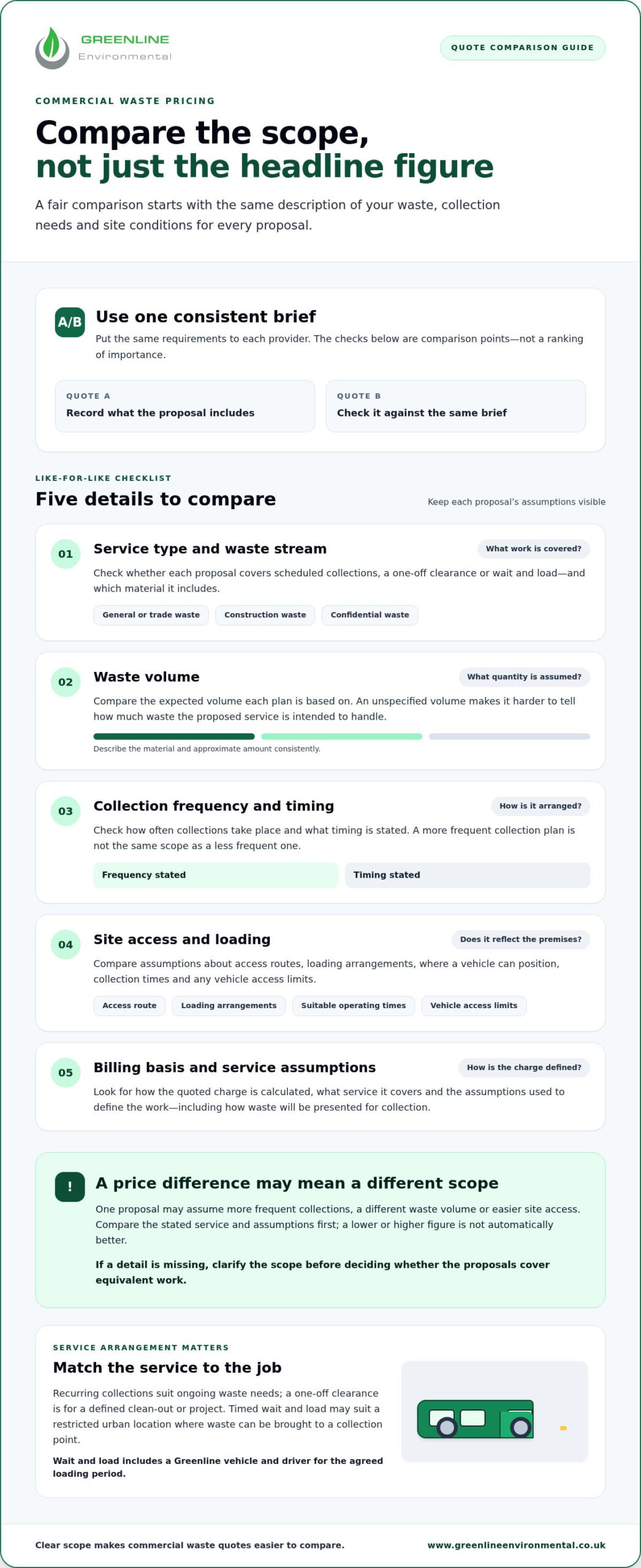
Look for a practical description of the service: whether it is recurring or one-off, which waste stream it covers and how collections are arranged. The quote should also state the assumptions used to define the work, such as the expected volume and how the waste will be presented for collection.
Site details help define the scope. In Central London, access routes, loading arrangements, available collection times and vehicle access limits can affect how a collection is planned. Include these details in the brief so the proposed service reflects the conditions at your premises.
- Service type: scheduled collection, one-off clearance or wait and load.
- Waste stream and volume: what material is included and the quantity the plan is based on.
- Collection arrangement: how often collections take place and how the waste is made accessible.
- Site requirements: access, loading and timing assumptions that shape the proposed work.
- Billing basis: how the quoted charge is calculated and what service it covers.
Why the lowest headline figure may not be comparable
Two figures can appear comparable while covering different levels of service. One proposal might include more frequent collections; another might assume a lower waste volume or different access conditions. Without those details, it is difficult to tell whether the price difference reflects equivalent work or a different scope.
For instance, a quote for regular collections should not be compared with a one-off clearance as though both cover the same task. An unspecified volume also makes a proposal harder to assess because it leaves unclear how much waste the planned service is intended to handle.
A lower or higher figure is not automatically better. Compare the stated scope and assumptions first, then assess whether the arrangement fits your waste stream, site and operational needs. A clear quote gives you a sound basis for that decision, without relying on the headline rate alone.
What shapes a commercial waste quote in London?
A tailored quote reflects more than how much waste leaves a site. The waste stream, volume, collection pattern and practical conditions at the premises all shape the service required. A clear commercial waste quote connects the type and amount of waste to a workable collection arrangement and the realities of the site.
Waste stream, volume and collection frequency
Start by identifying what your business produces and how regularly it needs removing. General or trade waste from day-to-day operations may need a recurring arrangement, while construction waste can vary with the work taking place. Confidential waste has its own handling needs. Separating these streams gives a more useful picture than describing everything simply as “business waste”.
Volume matters alongside type. A quote based on a small, steady amount may describe a different service from one covering larger or changing volumes. Set the collection frequency against the pattern of waste generation: too few collections may not suit the operation, while more frequent collections may not be necessary. Businesses planning regular collections can explore commercial general waste collections.
The Chartered Institution of Wastes Management provides a wider professional context for the sector. For your quote, the practical starting point is a clear description of the materials, approximate volume and collection pattern at your premises.
Site access and choosing the right service arrangement
Central London sites can have specific logistical constraints. Loading access, where a vehicle can position, the route from the premises to the collection point and suitable operating times can all affect how a service is organised. Include these details in your brief so the proposed scope reflects your location and does not assume straightforward access.
The right arrangement also depends on the job. Recurring collections suit ongoing waste needs; a one-off clearance is designed around a defined clean-out or project. In a restricted urban location, timed wait and load may suit a job where waste can be brought to a collection point. Greenline provides wait and load, with a Greenline vehicle and driver for the agreed loading period.
Share your waste types, estimated volumes, preferred collection pattern and site constraints to help define the scope. You can request a tailored commercial waste quote based on those details.
How to compare commercial waste quotes fairly
Compare proposals against the same description of your business’s needs. A structured comparison shows where services match and where a proposal makes different assumptions. Missing information is a reason to clarify the scope, not proof that extra charges are hidden or that the quote is unsuitable.
A like-for-like commercial waste quote comparison
Use a simple table and enter what each proposal says. Keep your requirements consistent across the columns, including the waste, expected volume, collection pattern and site conditions.
| Comparison point | Quote A | Quote B |
|---|---|---|
| Service type and waste stream | What service and material are covered? | What service and material are covered? |
| Frequency and timing | How often, and what timing is stated? | How often, and what timing is stated? |
| Volume and access | What quantity and site arrangements are assumed? | What quantity and site arrangements are assumed? |
| Included, conditional or excluded | Which details are clearly included or qualified? | Which details are clearly included or qualified? |
Record collection timing as well as frequency. A proposal might describe regular collections but leave timing or access assumptions broad. Mark those points as “not stated” rather than filling gaps with guesses. You can then see whether you are comparing equivalent arrangements and identify what needs clarification.
Keep the agreed service separate from conditional items and exclusions. For example, note whether a site constraint is included in the planned scope or described as dependent on circumstances. This makes transparent commercial waste pricing easier to assess without assuming that an unclear point will automatically change the bill.
Check environmental and service information alongside scope
Compare how each proposal describes the handling of collected waste. Look for clear information about whether materials are directed towards reuse, recycling or energy recovery, and whether the explanation relates to the waste stream in your quote. Avoid relying on broad recycling-rate claims that are not supported by information about the proposed service.
Environmental handling sits alongside your business’s legal responsibility for commercial waste. Read the government guidance for an overview, then check that each proposal describes its collection and disposal arrangements clearly enough for you to understand the service.
Container type and capacity can also affect how a collection arrangement works. Use a commercial bins guide to understand the options relevant to your site, then compare whether each quote describes the container assumptions it relies on.
Once you have set out the same requirements and marked any unanswered points, assess the proposals on scope rather than the headline figure alone. Request a tailored commercial waste quote based on your site, waste stream and collection needs.
How to prepare a clear commercial waste pricing brief
A concise brief helps turn your day-to-day requirements into a workable collection plan. Gather the details below before requesting a quote. Approximate information is more useful than leaving the scope blank, and you can explain where volumes or timings vary.
Information to gather before requesting a quote
- Set out your location and operating hours. Give the site address or area, the times your premises operate and any preferred collection windows.
- Describe access. Note where a vehicle can load, how waste reaches the collection point, any access restrictions and relevant site arrangements.
- Identify each waste stream. Separate materials such as general or trade waste, construction waste and confidential waste where relevant. This describes the service required more clearly than grouping different materials under a broad label.
- Estimate volume and pattern. Explain the amount of waste produced and whether it is steady, occasional or linked to particular work. Include your current collection pattern if you have one.
- Define the requirement. Say whether you need an ongoing collection, a project-based clearance or a time-sensitive arrangement, and identify the operational priorities the plan should accommodate.
Turn requirements into a practical collection plan
Use the information to describe the outcome you need. Regular business waste may suit a scheduled arrangement, while an office move or site project may call for a one-off clearance. Where access or loading conditions shape the job, explain those constraints so the proposed service reflects the site. For ongoing business requirements, explore commercial trade waste services.
Include environmental priorities too. If you want waste directed towards reuse, recycling or energy recovery where appropriate, state this in the brief. Clear information about waste streams and handling preferences supports a tailored plan and makes it easier to understand how the proposed service aligns with your business’s priorities.
Transparent commercial waste pricing depends on a clear brief. The better the information about waste, timing and access, the easier it is to shape a service around the work your business needs. Greenline tailors commercial arrangements to business requirements and urban logistics across Central London and the South East.
Ready to put your requirements into a quote request? Request a tailored commercial waste quote.
Get transparent commercial waste pricing from Greenline
A useful quote begins with the work your business needs done. Greenline Environmental provides commercial waste services across Central London and the South East, tailoring arrangements to waste type, collection requirements and site logistics. Sharing these details helps shape a proposal around the actual job rather than a generic service description.
A tailored approach to business waste requirements
Different requirements call for different arrangements. Ongoing business waste may suit scheduled collections, while an office move or clear-out may need a one-off clearance. Construction projects can require construction waste removal, and restricted access may make wait and load a practical option. Greenline also provides bin hire, event waste management and confidential waste shredding for relevant business needs.
If you are planning an office clear-out, explore Greenline’s office clearance service. Describing what needs removing, where it is located and how the collection point can be accessed helps define the proposed scope.
Commercial services are available 24 hours a day, seven days a week. Greenline works with local disposal partners focused on diverting waste from landfill through recycling, reuse and energy recovery. Clear information about the waste stream and collection arrangement helps connect your requirements with the appropriate service and handling plan.
Request a quote with a clear service brief
To prepare your request, bring together the key details: the types of waste your business produces, approximate volumes, how often collections are needed and whether the work is recurring or a one-off project. Include the site location, operating hours, access arrangements and practical constraints that could affect loading or collection timing. If environmental handling is a priority, outline that too.
This gives Greenline a clear starting point for understanding the work and tailoring the service to your business. Transparent commercial waste pricing depends on a defined scope, so a useful brief makes the proposed arrangement easier to understand and assess.
Request a tailored commercial waste quote for your site, waste streams and collection needs.
Make your next waste quote clear and tailored
A dependable commercial waste plan starts with a clear picture of the service: the waste streams, collection pattern and site arrangements. Compare proposals against that shared scope, not the headline figure alone. That is the practical foundation of transparent commercial waste pricing and a plan that fits your business without paying for a mismatched service.
Greenline Environmental tailors commercial waste arrangements to business needs and urban logistics across Central London and the South East. Services are available 24 hours a day, seven days a week, with local disposal partners focused on recycling, reuse and energy recovery.
Share your waste types, approximate volumes, collection needs and site requirements to define the work. Request a tailored commercial waste quote and take the next step towards a service plan that works for your business.
Frequently Asked Questions
What should a commercial waste quote include?
A clear commercial waste quote should describe the service, waste stream, collection frequency and relevant site arrangements. It should also state the assumptions behind the proposed plan, such as the volume or access arrangements it is based on. This lets you understand how the service is intended to work and what the proposal covers. Compare these details before headline figures, as quotes may describe different collection arrangements.
How can I compare commercial waste quotes fairly?
Give each proposal the same requirements: waste types, expected volumes, collection frequency, access and operating hours. Then compare the service scope and assumptions side by side. Note details that are described differently or left unclear rather than making assumptions about them. This helps you judge whether each proposal addresses the same operational need, instead of treating different services as comparable based on headline figures alone.
Why do commercial waste prices vary between businesses?
Commercial waste prices vary because businesses produce different waste streams and volumes, need different collection patterns and operate from sites with varying access arrangements. A recurring collection also differs from a one-off clearance or timed wait and load service. These factors shape the work involved. A tailored quote should reflect the requirements of the business and site, rather than rely on a generic figure that may not describe the service needed.
Can a business get a commercial waste quote without knowing exact volumes?
Yes. If exact volumes are not available, describe the waste types, current collection pattern and practical site requirements, and make clear which quantities are estimates. This gives the service team useful context for shaping a proposal. For example, explain whether the waste is produced steadily or varies with projects. Treat an approximate description as planning information, not as a guaranteed quantity or fixed service specification.
Does a commercial waste quote include recycling and disposal information?
A quote or service description should make relevant waste-handling arrangements understandable, including recycling, reuse or energy recovery where applicable to the waste stream. Look for a clear explanation rather than relying on an unsupported percentage or broad environmental promise. Greenline works with local disposal partners focused on diverting waste from landfill through these routes, helping businesses understand the environmental handling approach behind their commercial waste service.
Are recurring commercial waste collections priced differently from one-off clearances?
They are different service arrangements, so compare their scope separately. A scheduled collection describes an ongoing pattern for regular business waste, while an office or site clearance addresses a defined one-off requirement. Wait and load is another option, with a Greenline vehicle and driver provided for an agreed duration while waste is loaded. A clear quote identifies the service type and explains how it is intended to meet your requirements.
How do I request transparent commercial waste pricing in London?
Prepare a brief with your location, waste types, approximate volumes, collection frequency, operating hours and access arrangements. State whether you need regular collections, a one-off clearance or timed wait and load. Greenline tailors commercial services across Central London, including EC1, EC2, EC3, EC4, WC1, WC2, E1, SE1, SW1, SW8, SW7 and SW3, and the South East. Request a tailored commercial waste quote.