
What if your waste report could help keep a shopfitting project moving, not just document what’s been cleared? Tight schedules make it easy for collection details and waste destinations to end up in separate records. A clear environmental report for business waste brings those details together, giving you a more useful view of the materials leaving site and where they’re reported to go.
You’ll learn what to record for each waste stream, how to organise collection information and how to use the resulting picture when planning future clearances. For shopfitters working to demanding schedules, waste removal needs to fit the project as well as the paperwork. Greenline Environmental operates 24 hours a day, seven days a week, helping businesses coordinate clearance around practical site requirements. This guide connects reporting with day-to-day decisions, so waste information can support a more organised project from start to finish.
Key Takeaways
- An environmental report for business waste should give a structured picture of project waste, separate from published industry statistics.
- Set the project scope, site, timeframe and person responsible before logging collections.
- Record waste descriptions and available quantities consistently, without filling gaps with estimates.
- Compare records across projects to spot recurring materials and improve clearance planning.
What should an environmental report for business waste show?
An environmental report for business waste is a structured record of waste arising from a company’s activities or a defined project. For a shopfitting job, it should help the team understand what left the site, when it was collected and, where reliable information is available, its reported destination or treatment route. It’s a practical account of that project, not simply a sustainability statement.
Keep internal records distinct from published, aggregated business waste statistics. National or regional figures describe a wider group of businesses and can provide context, but they don’t show what happened on an individual shopfit in London. For background on the term, see What is Business Waste?
The reporting needed can depend on the business, activity and circumstances. Don’t assume one template answers every legal question. For requirements that apply to your situation, consult current official guidance.
Which information makes a shopfitting waste report useful?
Use consistent fields so project records can be understood and compared. Capture:
- Project dates, site location and the person maintaining the record.
- Material or waste stream, such as timber, metal or plasterboard, with a clear description.
- Collection date and details, plus the quantity where it’s recorded.
- The reported destination or treatment route when supporting records provide reliable evidence.
Keep separate entries for different materials rather than combining them into a broad label such as “fit-out waste”. Separate documented facts from estimates. If a quantity is estimated rather than recorded, label it clearly and note the basis where known. Don’t fill gaps with invented figures or present an estimate as a measured weight. This gives project teams a more dependable record for reviewing waste patterns and planning future work. For a considered approach to construction waste planning, building and construction waste consultancy can support the process.
How can shopfitters prepare a clear business waste report?
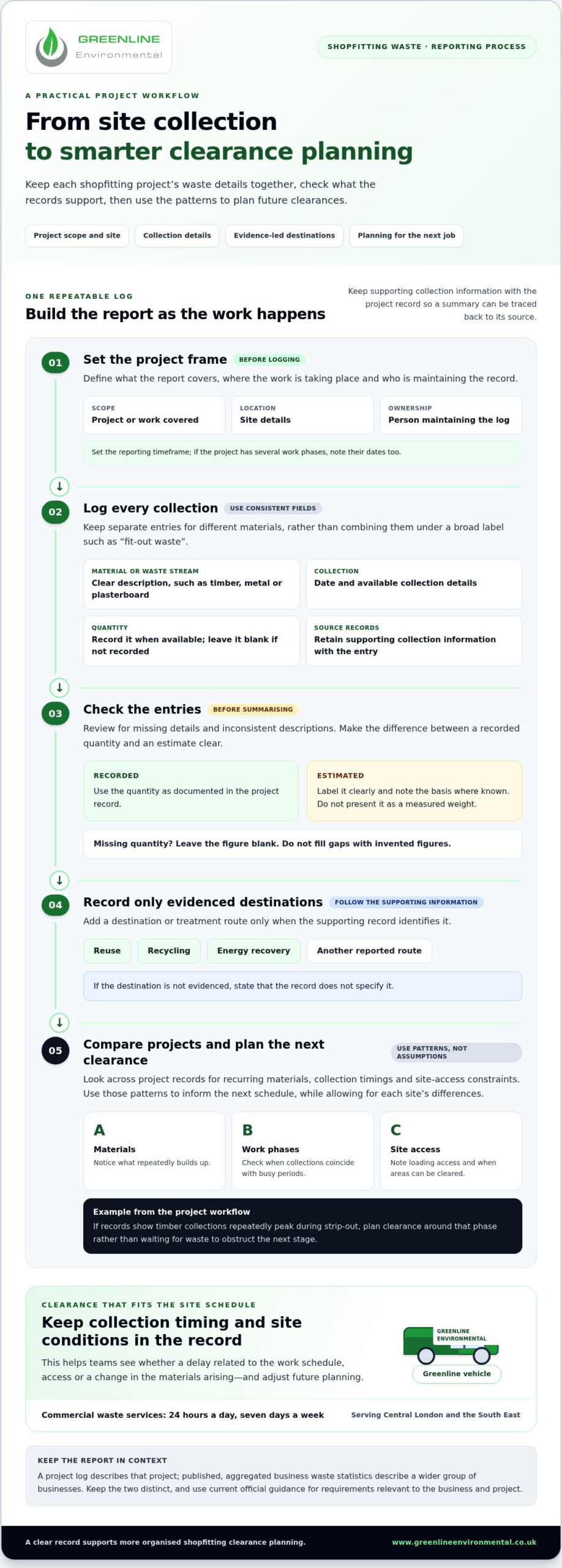
Build the report around the project, rather than trying to reconstruct waste movements at the end. Set out the work covered, site location and reporting timeframe, then name the person responsible for keeping the log. If a shopfitting project spans several work phases, note their dates too. A consistent scope makes the final summary easier to interpret and compare with later projects.
Turn site records into a repeatable reporting process
Keep one project log that site teams can update as collections take place. Use the same fields each time, and retain supporting collection information alongside each entry. This lets the person preparing the environmental report for business waste trace a summary back to its source rather than relying on memory.
- Log each collection with its date, waste description and available quantity. Use consistent names for recurring materials, and leave a figure blank if it wasn’t recorded.
- Review entries for missing details or inconsistent descriptions before producing the summary. Mark estimates clearly and don’t present them as measured quantities.
- Record reuse, recycling, energy recovery or another reported destination only when supporting information identifies that route. If the destination isn’t evidenced, state that the record doesn’t specify it.
Use current GOV.UK guidance to understand requirements relevant to your business and project. For project-specific planning, building and construction waste consultancy can help inform a considered approach to construction waste.
A reliable log supports better decisions, but collections still need to fit site logistics. For help planning construction waste removal around a project, request a project quote.
How can London shopfitters act on waste reports with 24-hour clearance?
A report becomes more useful when you compare it across projects. Look for materials that regularly build up, collection timings that coincide with busy work phases and points where site access complicates removal. If records show that timber collections repeatedly peak during strip-out, for example, plan clearance around that phase rather than waiting for waste to obstruct the next stage.
Use these patterns to inform future schedules, not to assume every site will produce the same volumes. Note practical constraints such as loading access and when areas can be cleared, then plan collections around the project’s sequence. A clear building site clearance plan can help coordinate removal with ongoing work. For constrained loading areas, a wait-and-load service can avoid the need for skip permits in restricted urban locations.
Coordinate reporting with site clearance and recovery
Keep collection dates and site conditions alongside the project record. That makes it easier to see whether a delay came from the work schedule, access or a change in the materials arising, and to adjust the next clearance plan accordingly. For busy shopfits, arranging a Greenline vehicle for clearance can help align waste removal with the work sequence.
Greenline Environmental serves Central London and the South East, with commercial waste services operating 24 hours a day, seven days a week. This gives shopfitters a way to coordinate clearance around demanding project schedules. Greenline’s local disposal partners focus on landfill diversion through recycling, reuse and energy recovery, while project records should reflect destinations only where supporting information provides evidence. This is relevant for projects across EC1, EC2, EC3, EC4, WC1, WC2, E1, SE1, SW1, SW8, SW7 and SW3.
Use reporting to guide practical decisions, and keep the record as the source of what was collected and reported. Shopfitters can request a quote tailored to their project’s clearance requirements.
Make your next fit-out easier to plan
Use each completed project to sharpen the brief for the next one. Over time, an environmental report for business waste can help your team make clearance planning part of the project schedule from the outset, rather than a task left until materials begin to accumulate. That forward planning supports smoother site operations and gives everyone involved a clearer basis for coordinating waste removal.
Greenline Environmental works with shopfitters to arrange commercial waste clearance around demanding project requirements. Share the type of work, site details and clearance needs to receive a quote shaped around your project.
Request a quote for your shopfitting waste requirements, and take the next step towards a more organised fit-out.
Frequently Asked Questions
Is an environmental report for business waste legally required in England?
There isn’t one universal environmental report required for every organisation. An internal environmental report for business waste is a management summary, while separate records or responsibilities may apply depending on your business, activities and waste. Check current GOV.UK guidance for requirements relevant to your circumstances, particularly if a project involves different waste types or changes in how waste is handled.
How often should a business review its waste data?
Choose a review rhythm that fits the work, then apply it consistently. A shopfitter might review the record at phase handovers and again during project close-out, so missing entries can be raised while the team still remembers the circumstances. If a collection is delayed or the work changes, note that against the relevant period rather than silently shifting it into another review.
Can a small business prepare its own environmental waste report?
Yes. A small business can prepare a useful internal summary using information it already holds, such as invoices, collection confirmations and project notes. Keep source documents together so entries can be traced, and mark any estimated figures clearly. This report doesn’t replace any separate regulatory records or obligations that may apply, so use current official guidance to understand those requirements.
What is the value of reporting waste from a shopfitting project?
A project report can give clients and internal teams a clearer basis for discussing what happened during a fit-out and what to plan differently next time. For example, comparing the intended clearance sequence with what took place can inform future handovers in busy areas such as EC1, EC2, EC3, EC4 or WC2. Only describe reuse or recovery outcomes when records support the claim.