

Landfill should be the last resort for commercial waste, not the default. Diverting commercial waste from landfill in the UK means prioritising prevention, reuse, recycling and recovery, where reasonably possible. For businesses, the first step is to understand what they discard and keep recyclable materials separate from general waste.
Waste collection is more than removing unwanted material from a site. How waste is sorted and handled also matters. This guide covers landfill diversion, using registered waste carriers and authorised facilities, and practical steps for responsible waste management. It also explains how to approach separation and documentation, so the process is clear from your premises to the next stage of recovery.
Key Takeaways
- Prioritise preventing waste, then consider reuse, recycling and recovery to keep suitable materials out of landfill.
- Separate recyclable materials at the source and use a waste audit to identify practical diversion opportunities.
- Use a registered waste carrier and an authorised facility, and keep the required waste transfer documentation.
- For shopfitting or construction waste, explore a managed removal approach that supports responsible sorting and onward handling.
What Is Landfill Diversion?
Landfill diversion means directing commercial waste towards reuse, recycling or recovery instead of disposal. UK businesses should prevent waste first, then reuse, recycle and recover materials where reasonably possible.
Waste diversion routes
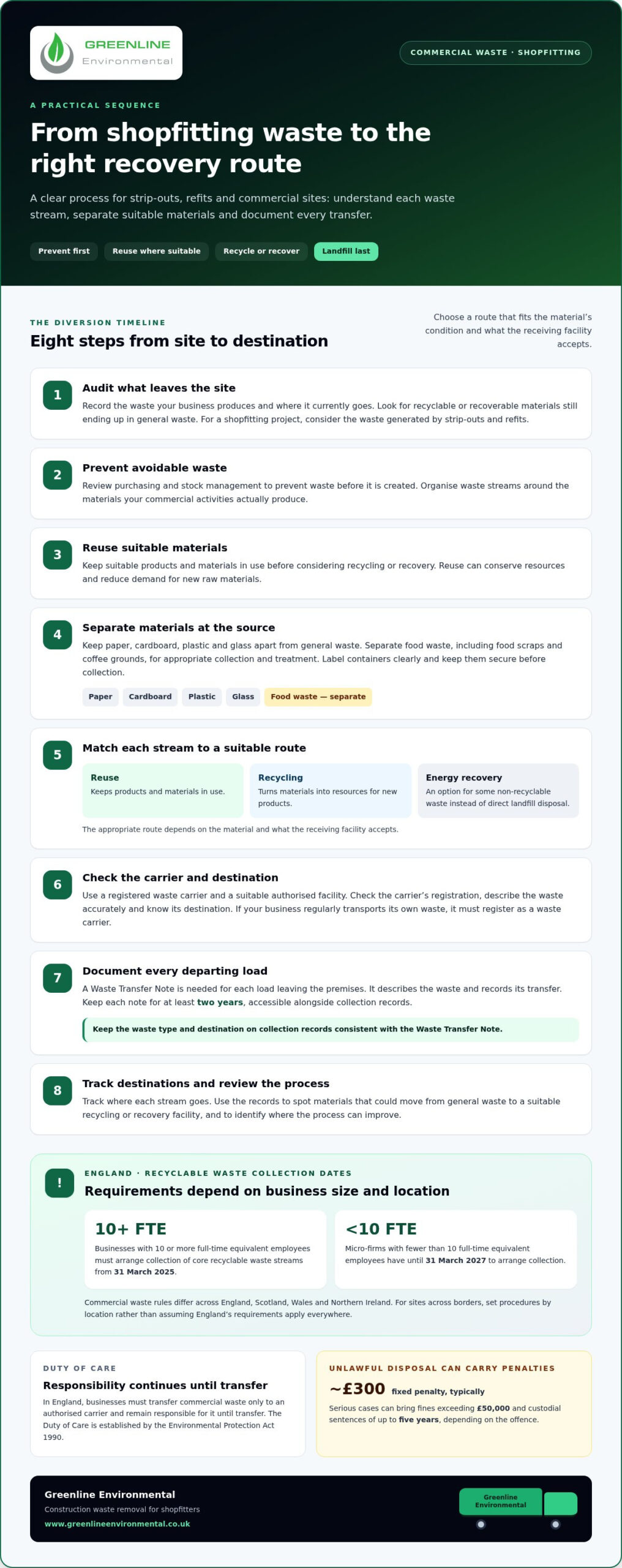
Reuse keeps products and materials in use, while recycling turns them into resources for new products. Energy recovery can provide an alternative for some non-recyclable waste instead of direct landfill disposal. Choose a route based on the material’s condition and what the receiving facility accepts. These steps can conserve resources and reduce pressure on landfill capacity.
Materials for recycling
Sort paper, cardboard, plastic and glass so recyclable materials stay separate from general waste. Keep food waste, such as food scraps and coffee grounds, apart for appropriate collection and treatment. In England, businesses with 10 or more full-time equivalent employees must arrange collection of core recyclable waste streams from 31 March 2025, according to the Department for Environment, Food & Rural Affairs. Micro-firms with fewer than 10 full-time equivalent employees have until 31 March 2027 to arrange collection.
Waste prevention and resource reuse
Start by reviewing what your business discards, then prevent avoidable waste through purchasing and stock management. Reuse suitable materials before considering recycling or recovery. These steps can conserve land and resources, support a circular economy and reduce demand for new raw materials. Business waste differs from household waste, so organise waste streams around the materials your commercial activities produce.
Trade waste collection and recycling
Commercial waste collection can take sorted materials to recycling or recovery facilities. Separate waste at your premises, label containers clearly and keep them secure before collection. A registered waste carrier and a suitable authorised facility are essential parts of the process. Collection and disposal costs depend on the waste type, quantity, collection frequency and treatment route; request a quote for your requirements.
Using registered waste carriers and authorised facilities
Commercial waste must be handled by an appropriate carrier and facility. Check the carrier’s registration, describe the waste accurately and know its destination.
For businesses diverting commercial waste from landfill in the UK, each load leaving the premises needs a Waste Transfer Note. Keep each note for at least two years, according to the Department for Environment, Food & Rural Affairs. The record describes the waste and documents its transfer. Keep it accessible alongside collection records.
Registering and checking a waste carrier
If your business regularly transports its own waste, it must register as a waste carrier. Before arranging collection, check that the carrier is registered to handle the waste. In England, businesses must transfer commercial waste only to an authorised carrier and remain responsible for it until transfer. The Environment Agency’s public register can be used to check a carrier’s registration.
Registration and destination both matter. Choose a carrier and authorised facility suited to the waste stream, whether general waste or separated recyclables. When diverting commercial waste from landfill in the UK, ensure each route supports responsible waste management. Keep collection details consistent with the Waste Transfer Note, including the waste type and destination.
Records and consequences of unlawful disposal
A Waste Transfer Note should identify the waste and record its transfer for each departing load. Store it for the required two years. Businesses must manage waste under the Duty of Care established by the Environmental Protection Act 1990, according to UK Parliament.
Illegal commercial waste disposal can lead to a fixed penalty notice, typically around £300 per offence. Serious cases can bring fines exceeding £50,000, and custodial sentences of up to five years, depending on the offence. Proper carrier checks, authorised destinations and complete records help protect your business and support lawful disposal.
Commercial waste landfill diversion
Effective diversion matches each waste stream to an appropriate recovery route and the rules that apply at each site. Businesses diverting commercial waste from landfill in the UK should tailor collection arrangements to the nation where each site operates.
Regional commercial waste rules
Commercial waste rules differ across England, Scotland, Wales and Northern Ireland. In England, businesses with 10 or more full-time equivalent employees must arrange collection of core recyclable waste streams from 31 March 2025, according to the Department for Environment, Food & Rural Affairs. Micro-firms with fewer than 10 full-time equivalent employees have until 31 March 2027.
Scotland’s landfill diversion efforts support climate targets and the circular economy. Businesses operating in Wales or Northern Ireland should follow the rules relevant to those nations rather than assuming England’s requirements apply. For sites across borders, set procedures by location and align collection arrangements with each site’s requirements.
Commercial waste sent to landfill
The UK would need around 21 million tonnes of landfill capacity per year even if government recycling-rate targets were met. This is an estimate of required capacity, not a measurement of how much commercial waste goes to landfill annually.
To identify diversion opportunities, record the waste your business produces and its current destination. Look for recyclable or recoverable materials still entering general waste, then plan collections to deliver them to suitable facilities. Diverting commercial waste from landfill in the UK can reduce reliance on finite landfill sites and help limit methane emissions. Track each stream’s destination to see where your process can improve. Request a tailored waste management quote to discuss collection arrangements for your business.
Greenline Environmental: Construction Waste Removal
Greenline Environmental provides Construction Waste Removal for shopfitters handling strip-outs, refits and changing site needs. Organised removal helps keep work areas clear while waste streams are managed as part of the project plan.
For busy sites, collection arrangements can be tailored to operational requirements. Greenline Environmental’s services are available 24 hours a day, 7 days a week, supporting businesses that need waste management to fit around their working schedule. Event organisers can also use Event Waste Management, while Confidential Waste Shredding addresses sensitive business documents.
Consider Construction Waste Removal when refurbishment or fit-out work creates material that needs clearing from site. Share the project requirements and waste types so the removal can be planned around the job. Contact Greenline Environmental to discuss your commercial waste needs.
Make your next project a diversion opportunity
Before your next shopfit or refurbishment, map the materials the work will produce and plan their removal alongside the project schedule. This makes diverting commercial waste from landfill in the UK a practical site decision: identify what can be reused or recycled, then arrange suitable collection for the remainder.
Greenline Environmental supports commercial projects with Construction Waste Removal, Office Clearance and Wait and Load. The right service depends on the work underway and the materials to be cleared. A clear plan helps keep your site orderly and puts responsible waste handling into practice.
Take the next step by outlining your project and its waste requirements. Contact Greenline Environmental to discuss your requirements and plan a more considered approach to waste. Every well-planned project is an opportunity to make better use of resources.
Frequently Asked Questions
What are the UK legal requirements for businesses disposing of commercial waste?
UK businesses must manage commercial waste responsibly under the Duty of Care established by the Environmental Protection Act 1990. Keep waste secure, describe it accurately and transfer it only to an authorised carrier. Complete a Waste Transfer Note for each load leaving your premises and retain it for at least two years, according to the Department for Environment, Food & Rural Affairs.
What is the waste hierarchy and how should businesses apply it?
The waste hierarchy prioritises prevention, followed by reuse, recycling, recovery and disposal. Apply it when planning purchases and handling materials: order only what a job needs, reuse suitable packaging, then separate recyclable waste. For example, a shopfitting team can assess clean surplus materials for reuse before arranging recycling or recovery for the rest.
What are the alternatives to landfill for commercial waste in the UK?
Alternatives include reuse, recycling, composting and energy recovery. Food waste may go for anaerobic digestion or composting, while suitable inert materials such as soil and rubble can be used in quarry restoration. The right route depends on the material and the facility. Sorting waste before collection helps keep recoverable materials separate from residual waste.
How can UK businesses reduce, reuse, recycle, or recover commercial waste?
Start with a waste audit: record what each activity produces, where it arises and how it is currently handled. Use the findings to avoid unnecessary purchases, identify materials for reuse and improve separation. Clear signs at collection points and staff guidance can reduce waste mixing, especially when different teams produce distinct streams.
How can a business find licensed commercial waste carriers and recycling facilities locally?
In England, use the Environment Agency’s public register to check a carrier’s registration, then confirm the proposed destination is an authorised facility. For premises in EC1, EC2, EC3, EC4, WC1, WC2, E1, SE1, SW1, SW3, SW7 or SW8, consider site access and collection arrangements alongside the waste streams produced.