

A local waste firm isn’t automatically the right choice for every London business. Choosing a reliable waste contractor in London means looking beyond proximity to check that the service suits your waste, handles recycling responsibly and provides the right paperwork. London businesses should receive a waste transfer note for each collection and, according to the UK Government, keep these notes for at least 2 years.
Prompt collection and a tidy site matter, but traceable waste handling matters too. This guide explains how to assess a firm’s reputation, recycling practices and documentation, then compare local operators with London-wide services. You’ll have a clearer basis for choosing a contractor that suits your location, waste streams and working schedule.
Key Takeaways
- Compare quotes by checking what each covers, including collection arrangements and any terms that could affect the final service.
- Use references and customer feedback to assess whether a firm works efficiently, communicates well and leaves the site tidy.
- Look for clear recycling practices and paperwork that helps you keep an organised record of waste collections.
- Choose between a local operator and a London-wide service by weighing site access, traffic and parking against the scale and location of the job.
Is it a reputable London junk removal company?
A sound assessment combines a valid waste carrier licence, clear quote terms and services suited to your site. Compare proposals on the same waste type, load size and collection arrangements.
Waste Carrier Licensing and Certifications
Check that the contractor has appropriate licensing for the waste collection and disposal involved. Ask what any company certifications cover and whether they apply to the waste handling involved; a general badge is not a substitute for licensing evidence. For shopfitters, confirm that the proposed service can handle the specific waste generated by the works and explain its disposal route.
Quotes and Contract Terms
Request an upfront quote that describes the waste, estimated load size, collection method and disposal arrangements. Compare like with like: a flexible collection for a small, ready-to-load amount is different from a larger clearance requiring more labour or vehicle capacity. Read the contract for included services, collection timing, extra-charge conditions and cancellation terms. Ask for unclear wording to be explained before agreeing, and compare 2-3 quotes rather than choosing on price alone.
Regional Coverage and Borough Requirements
A nationwide contractor may suit businesses coordinating work across several regions, while a local firm may know the area’s access, traffic and parking constraints. In London, check that the service covers your worksite and can plan around its loading arrangements. Borough rules and commercial waste requirements can vary by area and waste stream. Businesses must separate certain recyclable materials by law, so confirm how the collection plan handles each relevant material.
Risks of Unlicensed Waste Carriers
Using an unlicensed carrier risks improper disposal, environmental harm and a poor record of where waste went. Waste offences can also lead to penalties for businesses. Check the licence before collection and retain paperwork recording the transfer. Match claims about recycling or flexible service with clear collection and disposal details, rather than accepting them in place of evidence.
Do You Recycle Waste & What Documentation Do You Provide?
For commercial waste management, ask what happens after each collection, not just how waste leaves your site. Businesses should use licensed waste carriers and keep transfer records. A waste transfer note records the waste and its movement, helping you maintain a clear compliance trail. Ask the waste management company how it provides these notes and whether its reporting matches your collection schedule.
Keep the records securely. According to UK Government, businesses should keep waste transfer notes for at least 2 years. Businesses handling hazardous waste should obtain hazardous waste consignment notes when applicable. Check that the paperwork identifies the relevant waste and transfer, and file each record so it can be found alongside the corresponding collection details.
Recycling practices matter too. Ask how the company separates materials and directs them for reuse or recycling wherever possible. Businesses in London must separate certain recyclable materials by law, so check that the proposed arrangements account for the materials your site produces. For example, a shop refurbishment may create distinct waste streams that need separate handling rather than one mixed load.
Before booking, compare the written quote with the contract. It should explain collection frequency, the waste types covered and how changes in volume are handled. Ask how additional charges are calculated if the load differs from the estimate or needs different handling. Clear terms make flexible arrangements easier to manage and help you compare quotes on the same basis. Requesting a quote for your commercial waste collection is a practical next step.
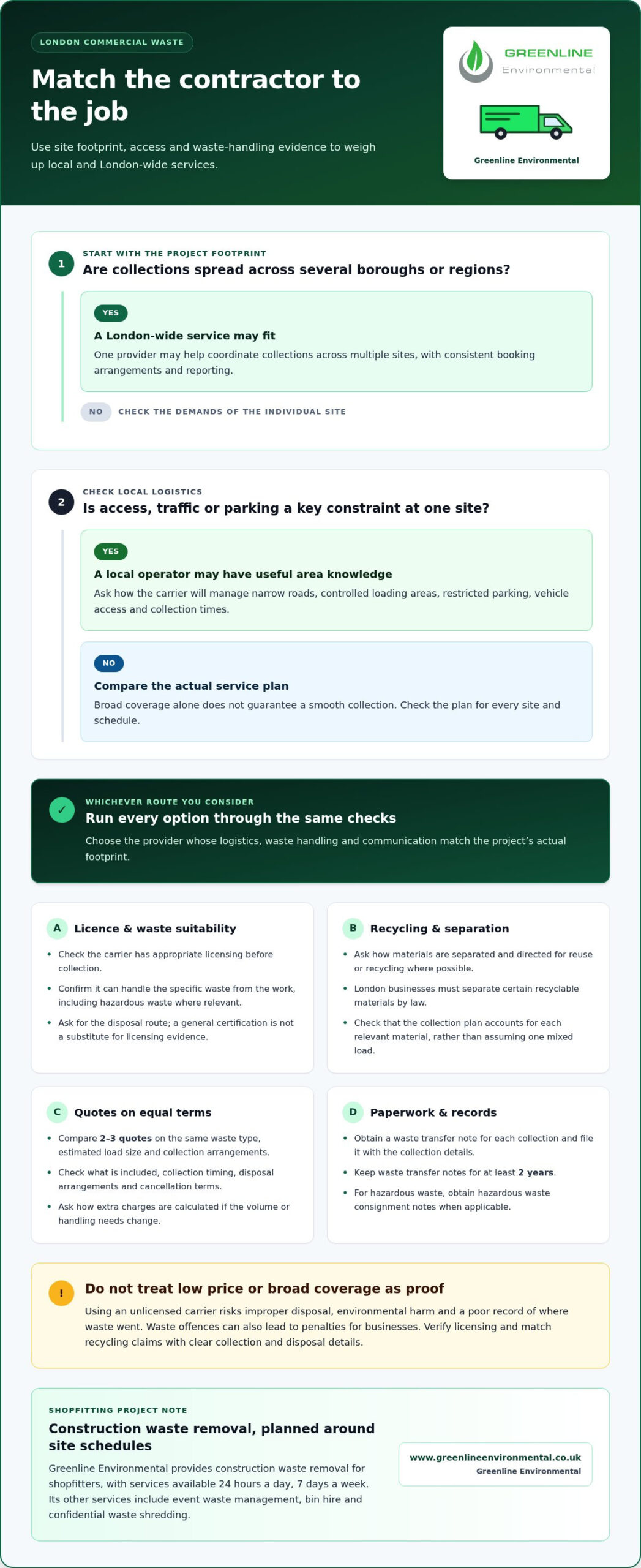
Choosing between London-wide and local waste removal firms
A London-wide waste removal firm may suit shopfitters managing projects across several boroughs or regions. One provider can coordinate commercial waste collection across multiple sites, with consistent reporting and booking arrangements. A local service may be better suited to a smaller job, with knowledge of nearby access, traffic and parking. The right fit depends on your site locations and whether collections need coordinating.
For a single clearance, assess the firm’s experience with your specific site. Narrow roads, controlled loading areas and restricted parking can shape collection logistics in London. Ask how the waste carrier plans vehicle access, loading and collection times. For a multi-site project, compare how each firm manages separate schedules and keeps communication consistent across locations.
Match the service to the waste stream, not just the contractor’s coverage map. A firm should be equipped to handle the specific material you need removed, including hazardous waste where relevant. Ask how it sorts recoverable materials for recycling or reuse, and how it limits landfill disposal. These answers help assess whether its approach supports your sustainability priorities.
Compare quotes against the same practical brief: site addresses, waste types, estimated volumes, access constraints and clearance dates. A London-wide firm may simplify repeat bookings across boroughs, while a local operator may suit one site with unusual access needs. Check that the collection plan works at every location rather than assuming broad coverage guarantees a smooth job. Choose the provider whose logistics, waste handling and communication match the project’s actual footprint.
Greenline Environmental: Construction Waste Removal
Greenline Environmental provides Construction Waste Removal for shopfitters managing waste during fit-outs and site clearances. Its services are available 24 hours a day, 7 days a week, supporting businesses that need waste management planned around demanding site schedules.
Greenline Environmental also offers Event Waste Management, Bin Hire and Confidential Waste Shredding. These services help businesses organise waste handling for events, work sites and confidential document disposal. When discussing your requirements, describe your site, waste type and collection needs so the service can be tailored to the project.
For a structured approach to construction waste removal on your shopfitting project, contact Greenline Environmental to discuss your requirements.
Plan your next site clearance with confidence
Choosing a reliable waste contractor in London can help keep a shopfitting project organised from initial strip-out to final clearance. Include waste handling in the site plan, aligning collection arrangements with access, work stages and the materials generated. This lets your team focus on the fit-out while managing waste as a defined part of the job.
Greenline Environmental offers Wait and Load, Office Clearance and Construction Waste Removal for businesses with different clearance needs. Share your project’s location, waste types and schedule to start a practical conversation about the right approach.
Contact Greenline Environmental to discuss your requirements and take the next step towards a well-organised clearance.
Frequently Asked Questions
How to Choose the Right Waste Management Provider?
Choosing a reliable waste contractor in London starts with matching the service to your waste stream and site routine. For example, a shopfitter clearing a unit in EC1 needs a plan for fit-out debris, access and staged collections. Compare each written scope, collection arrangements, records and communication process. Then establish how the provider will manage changes if the work schedule shifts.
What to Look for in a Commercial Waste Company?
Look for a licensed waste carrier with suitable insurance, clear service terms and experience handling your type of commercial waste. For sites in EC1, EC2, EC3, EC4, WC1, WC2, E1, SE1, SW1, SW8, SW7 or SW3, consider access, loading space and collection timing. Ask how the service accommodates your operating hours and who handles booking changes.
What waste transfer notes and duty-of-care records should a London business keep?
Keep the waste transfer note for each collection, alongside related booking or collection records that help identify what left your site and when. According to the UK Government, businesses should keep waste transfer notes for at least 2 years. If your business handles hazardous waste, retain the relevant consignment notes as well. Organise records by site or collection date for easier retrieval.
What factors affect waste contractor prices in London, including congestion and access charges?
Quotes can vary with waste type and amount, distance travelled, load size, collection method, and any extra labour or vehicle capacity required. Compare site access and loading arrangements, and check the contract for additional charges if the load or handling differs from the estimate.
How to compare London waste contractors on recycling rates and landfill diversion
Ask each contractor how it separates materials, directs them for reuse or recycling, and limits landfill disposal. Compare the written explanations for your specific waste streams; the article provides no recycling-rate figures.