

For a business, bulky items should be kept at an agreed collection point on the premises, where they can be loaded safely. Getting rid of bulky office waste means planning how furniture, equipment and other large items will be removed, reused or disposed of, rather than leaving them on a public pavement.
It can be difficult to clear large items without disrupting work, especially during an office move or shop fit-out. This guide explains what counts as bulky office waste, where to put items for collection and how to support more sustainable disposal. You’ll also learn how commercial collections can help businesses manage clearances efficiently, including when work needs to fit around a busy operating schedule.
Key Takeaways
- Identify which office items qualify for bulky collection and which may be excluded before arranging removal.
- Set aside usable furniture and equipment for reuse or refurbishment before considering recycling or disposal.
- Plan an accessible collection point on your premises to help large items be removed safely and efficiently.
- For shop-fitters managing a clearance, explore how Greenline Environmental’s commercial waste services can support the work, including Construction Waste Removal.
Why is it difficult to get rid of bulky items sustainably?
Council schemes differ in the items they accept, how bookings work and where collection takes place. Household collection rules therefore may not apply when planning to remove bulky items from an office.
Items excluded from collection
Check the local council’s exclusions before setting items out. Soft furnishings may need a separate booking, and some councils exclude cooling appliances such as fridges and freezers. Where white goods are accepted, they may need to be empty before collection. These conditions affect which items can be removed together, so sort furniture and appliances before arranging a collection.
Household schemes may accept items such as cookers, carpets, furniture suites and mattresses. Some also accept garden branches, subject to preparation rules. These collections may exclude business waste, so workplace clearances need a route suited to commercial items rather than assumptions based on domestic services.
Charges and item limits depend on the council and the waste. Soft furnishings may need a separate booking or incur a different charge, and some schemes set separate limits for standard and non-standard bulky items. Check the relevant collection conditions before arranging removal, particularly when an office clearance includes mixed furniture, appliances and materials.
Arranging large-item collection
Book before placing items outside and follow the collection-day instructions. A council may require items at the kerbside or front boundary by a specified time. Crews may not enter buildings, garages or sheds, so items need to be accessible from the designated collection point.
For an office clearance, separate business waste from household items and identify a safe, accessible collection point. Household booking arrangements may not suit a shop fit-out or workplace clearance.
What is bulky waste?
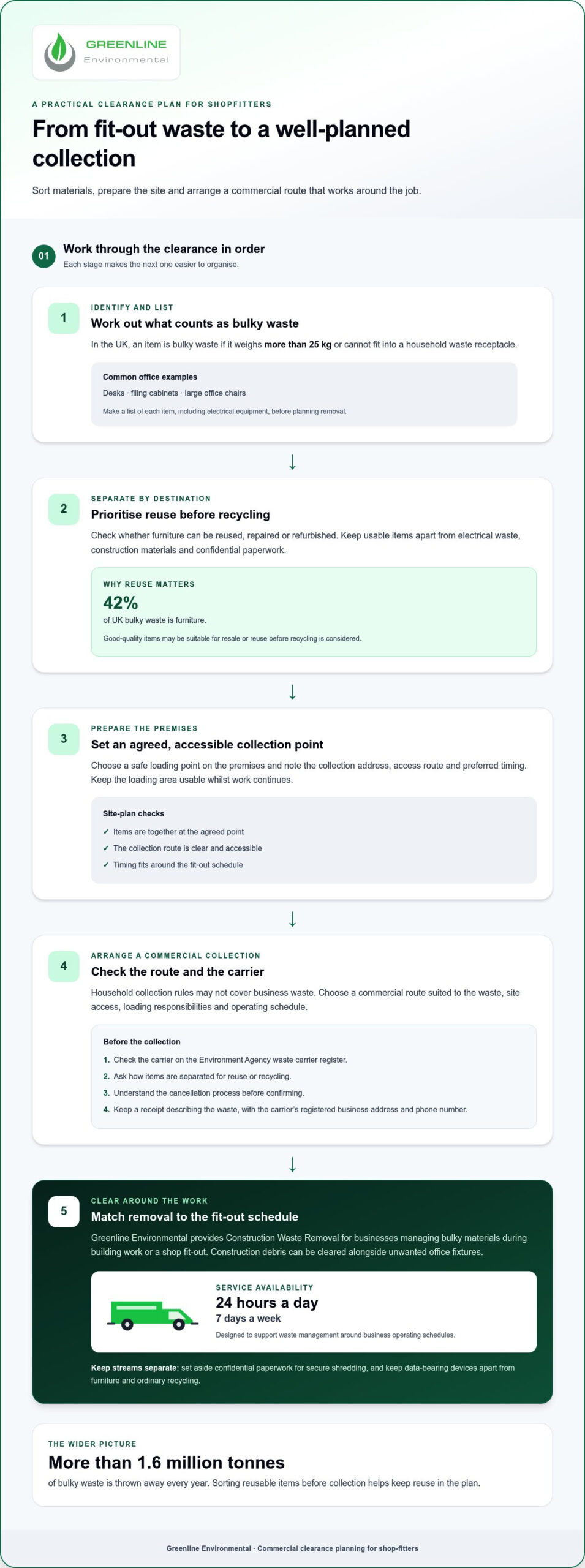
In the UK, bulky waste is legally defined as an item weighing more than 25 kg or one that cannot fit into a household waste receptacle. Desks, filing cabinets and large office chairs are common examples. The definition concerns an item’s weight or size, not whether it comes from a home or workplace.
Before disposal, assess whether office furniture can be reused, repaired or refurbished. Furniture, such as sofas, makes up 42% of UK bulky waste. Good-quality items may be collected for resale by charities such as the RSPCA and British Heart Foundation. Selling usable desks or offering them for reuse can extend their working life before recycling is considered.
Household schemes may accept furniture, mattresses, cookers, carpets and some garden items, but accepted lists and extra charges vary. Check the council’s rules before booking, especially for soft furnishings and appliances. Separate unwanted white goods and electrical items from furniture so they can follow an appropriate collection route.
Most UK retailers must provide a way to dispose of old household electrical and electronic equipment when a customer buys a new version of the same item. This take-back option applies to household purchases; businesses should arrange a suitable commercial route for workplace equipment. For companies managing redundant IT assets across regions, non-profit initiatives such as era.ca highlight how unwanted corporate electronics can be refurbished, donated or responsibly recycled. Keep reusable office items separate from electrical waste and materials intended for recycling.
Fly-tipping can lead to prosecution, and leaving waste without an arranged collection can create legal and environmental problems. Businesses should use a registered waste carrier and keep a receipt describing the waste, including the carrier’s registered business address and phone number. Arrange secure shredding for confidential paperwork, and keep data-bearing devices separate from furniture and ordinary recycling.
Commercial bulky waste service
A commercial collection can be planned around workplace waste, access and operating needs. For shop fitters clearing chairs, shelving and electrical items, sorting materials first helps organise removal and recycling. A clear collection plan also helps keep loading areas usable while work continues.
Comparing collection with skip hire
A removal service collects bulky items from an agreed point, which can suit premises with limited space or a tight fit-out schedule. Skip hire requires room for the skip and staff to load it. Compare site access, waste type, loading responsibilities and how long the premises can accommodate equipment. Household arrangements may not cover business waste.
Finding licensed local collectors
Search for commercial waste collectors serving your area, then check their registration on the Environment Agency waste carrier register. Keep a receipt describing the collected waste, including the carrier’s registered business address and phone number. Responsible handling involves checking that waste is dealt with appropriately, rather than simply taking items away.
Before booking, list each bulky item, including electrical equipment, and note the collection address, access route and preferred timing. This helps shape the service around the premises rather than treating office contents as household waste. Ask how items are separated for reuse or recycling, and understand the cancellation process before confirming. More than 1.6 million tonnes of bulky waste is thrown away every year, making reuse an important consideration. Clear arrangements help businesses remove unwanted furniture without obstructing staff or site work.
Greenline Environmental: Construction Waste Removal
Greenline Environmental provides Construction Waste Removal for businesses managing bulky materials during building work or a shop fit-out. It is a practical option when renovation debris needs clearing alongside unwanted office fixtures, rather than treating the project as a household collection.
Shopfitters can arrange removal as part of keeping a work area organised while installations progress. Greenline Environmental’s services are available 24 hours a day, 7 days a week, supporting businesses that need waste management to fit around their operating schedule. Separate reusable office furniture and confidential paperwork from construction materials so each waste stream can be handled appropriately.
For a workplace clearance involving confidential documents, Greenline Environmental also provides Confidential Waste Shredding. Contact the team to discuss your commercial waste requirements.
Plan the next stage of your clearance
Use the clearance to plan how materials will leave the site, not just what needs removing. For shopfitters, coordinating waste removal with the work schedule can help keep access routes clear and reduce disruption as the space changes. Separate office furniture, construction materials and confidential paperwork so each can be managed through the appropriate service.
Greenline Environmental offers rapid collection services, Office Clearance and Construction Waste Removal for business requirements. These services can support a planned office refresh or a shop fit-out with bulky items and building waste to clear. If you’re ready to organise the next step in getting rid of bulky office waste, contact Greenline Environmental to discuss your requirements. A considered clearance plan can help your team move forward with a more orderly site.
Frequently Asked Questions
Where do I leave my items for collection?
For a commercial collection, agree an accessible collection point at your premises rather than leaving items on a public pavement. Keep the route clear of parked vehicles, staff and customers, and group items so the crew can identify them. In busy areas such as EC1 or SE1, consider how loading access and the site’s working hours affect the collection plan.
What can I have collected?
Commercial collections can include bulky office furniture such as desks, filing cabinets, shelving and chairs. Accepted materials depend on the service and waste type, so separate electrical equipment, construction materials and confidential paperwork from general furniture. Consider reusable items for donation or resale before disposal. Sorting helps keep different materials on suitable routes.
What counts as bulky office waste in the UK?
Office waste is generally considered bulky if an item weighs more than 25 kg or cannot fit into a household waste receptacle. Examples include a large boardroom table, a filing cabinet or several stacked desks. The household-receptacle test is a useful size guide, but businesses should arrange a commercial route for workplace items rather than treating them as household waste.
How can businesses dispose of bulky office waste legally in the UK?
Use a registered waste carrier and keep a receipt describing the collected waste, with the carrier’s registered business address and phone number. The Environment Agency waste carrier register is identified as a place to check registration. Don’t leave furniture on the street without an arranged collection. For offices in WC1 or SW1, plan removal around site access and keep items on private premises until collection.
How much does bulky commercial waste collection cost in the UK?
The cost depends on the waste volume or weight, labour, transport and disposal requirements. A timed Wait and Load collection is charged according to the vehicle and driver time, while a one-off clearance reflects the waste removed. For an office in EC2 or E1, provide an item list and access details when requesting a quote, so the requirements can be assessed accurately.