

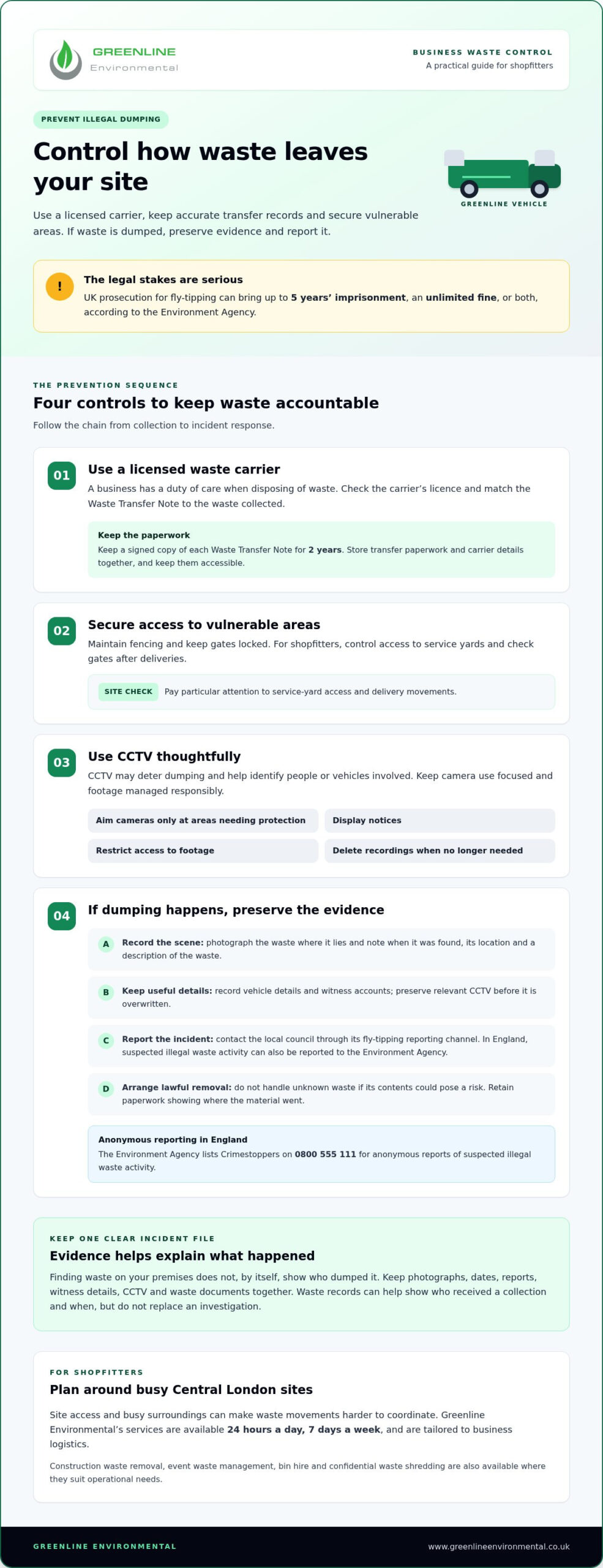
Preventing illegal dumping at my business starts with controlling how waste leaves your site: businesses have a duty of care under the Environmental Protection Act and must use a licensed waste carrier. Keep a signed copy of each Waste Transfer Note for 2 years, according to the Environment Agency. Prosecution for fly-tipping in the UK can bring up to 5 years’ imprisonment, an unlimited fine, or both, according to the Environment Agency.
It’s understandable to think that handing rubbish to someone else ends your responsibility, but sound records and careful waste arrangements matter. This guide explains why fly-tipping is illegal, what businesses must do when disposing of waste, and what prosecutions and penalties may follow. It also covers practical steps for preventing illegal dumping at my business and protecting your premises, reputation and the surrounding community.
Key Takeaways
- Understand why fly-tipping is illegal and how your business’s waste duty of care applies.
- Keep a clear record of waste movements and make responsible arrangements for its removal.
- Learn how responsibility for dumped waste can depend on the circumstances and which UK nation the site is in.
- See the potential consequences of prosecution and the practical steps that can help reduce risk.
1. Fly-tipping is illegal
Fly-tipping means leaving waste unlawfully, including on business land without permission. The Environmental Protection Act places a duty of care on every business disposing of waste. Preventing illegal dumping at my business starts with using a licensed waste carrier and keeping a signed Waste Transfer Note for 2 years, according to the Environment Agency.
Report dumping to the local council through its fly-tipping reporting channel, with the location and waste description. For suspected illegal waste activity, the Environment Agency lists Crimestoppers on 0800 555 111 for anonymous reports.
After an incident, photograph the waste where it lies and note when it was found. Record vehicle details and witness accounts, and preserve relevant CCTV footage before it is overwritten.
Don’t handle unknown waste if its contents could pose a risk. Arrange lawful removal through an appropriate waste route and retain paperwork showing where the material went.
Preventing illegal dumping at my business also means checking the carrier’s licence and recording each waste transfer accurately. Match the Waste Transfer Note to the waste collected, then keep the documents accessible.
2. Prosecutions and penalties
Fly-tipping can lead to criminal prosecution, not just removal costs or reputational damage. According to the Environment Agency, UK prosecution for fly-tipping can result in up to 5 years’ imprisonment, an unlimited fine, or both. The maximum penalty signals the seriousness of the offence.
Enforcement is active. In England, 211 waste-crime prosecutions were achieved over the three years up to March 2025. Those cases resulted in £640k in fines and 20 custodial sentences over the same period. These outcomes show that waste offences can bring consequences for individuals and businesses.
Financial investigations can extend beyond fines. In 2024/2025, the Environment Agency’s Economic Crime Unit secured six account freezing orders, freezing £2.9 million. It also obtained 13 confiscation orders totalling £1.55 million. These measures target proceeds linked to waste crime, alongside criminal proceedings.
For a business, clear records help demonstrate how waste was handled and transferred. Keep waste descriptions, transfer paperwork and carrier details together, then respond promptly to any enforcement enquiry. If waste from your site is dumped unlawfully, preserve relevant documents and incident evidence rather than altering or discarding them.
Acting early can help contain a waste problem before it escalates. If dumped material needs lawful removal, request a quote for waste clearance and explain the waste and site circumstances.
In Harborough District Council’s area, anyone caught fly-tipping can be issued a £300 fine without prosecution through the courts. That route sits alongside the criminal penalties described above, so the consequences may differ according to the enforcement action taken.
Proceeds recovered under the Proceeds of Crime Act can run into hundreds of thousands of pounds. Operating an illegal waste site can result in unlimited fines. These penalties underline why businesses should make lawful waste handling a compliance priority and document decisions about storage, transfer and disposal.
3. Who is responsible for waste fly-tipped on business land in England, Scotland, Wales and Northern Ireland?
Waste found on your premises does not, by itself, show who dumped it. Investigators need to establish who deposited it, how it arrived and whether business waste records connect it to a particular transfer. Keep the distinction clear: finding waste and proving who left it are separate issues.
Across England, Scotland, Wales and Northern Ireland, record the discovery promptly. Photograph the waste where it lies, note access points and preserve relevant CCTV footage. A delivery record, witness account or vehicle image may help establish whether a load came from a neighbouring site or a contractor.
Your business’s own waste arrangements also matter. The duty of care applies when a business disposes of its waste, so retain transfer paperwork and carrier details. If waste collected from your premises later appears dumped, those records can help explain who received it and when, though they don’t replace an investigation into what happened.
Practical responsibilities may arise before the dumper is identified: the business controlling the site may need to secure the area and arrange safe removal. The right steps depend on the waste, its location and any immediate risks. Don’t disturb unknown materials; record their position and report the incident to the relevant local council. In England, suspected illegal waste activity can also be reported to the Environment Agency.
Keep a single incident file with photographs, dates, reports, witness details and waste documents. Apply the same evidence process in each UK nation, then follow the instructions of the authority handling the report. For help arranging removal of dumped waste from business land, request a quote for fly-tipping clearance.
In England, the Environment Agency and its partners stopped 743 illegal waste sites in 2024/2025. Of these, 143 were high risk. The Environment Agency brought 229 waste sites into regulation and responded to 203 illegal dumping incidents, of which 98 were within its remit.
Greenline Environmental: Construction Waste Removal
Greenline Environmental provides Construction Waste Removal for businesses managing building, refurbishment or shopfitting work. If construction offcuts and packaging are building up on site, planned removal can help keep work areas clear and waste handling organised.
For shopfitters working in Central London, site access and busy surroundings can make waste movements harder to coordinate. Greenline Environmental’s services are available 24 hours a day, 7 days a week, and are tailored to business logistics. Event Waste Management, Bin Hire and Confidential Waste Shredding are also available where they suit your operational needs.
Share the waste type and site requirements when arranging support, so removal can be matched to the project. Contact Greenline Environmental to discuss Construction Waste Removal for your business.
Build a waste plan into your next project
Preventing illegal dumping at my business starts before waste accumulates: assign responsibility, set collection points and keep transfer records organised. For shopfitters, agreeing how construction waste will leave the site helps keep busy work areas orderly and avoids last-minute decisions.
Greenline Environmental supports businesses with Construction Waste Removal, rapid clearance services and Office Clearance. Choose the service that fits the work, whether you’re clearing a commercial space or managing waste from a refurbishment. A clear arrangement gives your team a defined next step when materials need to be removed.
Contact Greenline Environmental to discuss waste removal for your business. A well-organised site starts with a considered plan.
Frequently Asked Questions
What are the UK laws on illegal dumping on private business premises?
Fly-tipping is unlawful, and businesses have a legal duty of care when disposing of their waste. For a business in Central London, this means arranging waste disposal responsibly and retaining records that show how its waste was handled. Waste dumped by someone else on private land does not, by itself, establish who committed the offence; report it and preserve relevant evidence.
What are the fines and penalties for fly-tipping or failing to secure business waste in the UK?
According to the Environment Agency, prosecution for fly-tipping in the UK can result in imprisonment for up to 5 years, an unlimited fine, or both. The consequences depend on the offence and evidence; failing to secure business waste should not automatically be treated as a fly-tipping conviction. Keep waste arrangements controlled and records accessible, especially during busy shopfitting or refurbishment work.