

For shopfitters working to tight opening or refit deadlines, the biggest influence on a wait and load quote may be how straightforward the waste is to collect. Unclear pricing makes budgets harder to manage, especially when a busy London shopfitting site has restricted access or a short loading window. To understand the wait and load service cost London shopfitters need to budget for, start with the details of the job rather than a one-size-fits-all figure.
Greenline’s timed service provides a Greenline vehicle and driver while your shopfitting team loads the waste. The volume, waste type, loading arrangements and site access all help shape a tailored quote. The service is available 24 hours a day, seven days a week, helping shopfitters plan collections around fit-out schedules, restricted access and handover deadlines.
This guide explains which shopfitting job factors influence a quote, what information to prepare and how to organise a smoother collection. It also covers how responsible waste handling fits into the service, so you can plan from estimate through to removal during a shop refit or installation.
Key Takeaways
- The wait and load service cost London shopfitters are quoted depends on the waste, loading effort, access and time the shopfitting job requires.
- Share a clear description of fit-out waste and estimated volume to help plan the right Greenline vehicle and loading window.
- Greenline’s wait and load service is available 24 hours a day, seven days a week, with your team loading the waste while the driver waits.
- Wait and load can suit shopfitters working in restricted retail locations where there is little room to keep a skip on site.
- Prepare the shop unit, access details and loading arrangements before requesting a quote to make collection planning smoother.
What determines wait and load service cost in London?
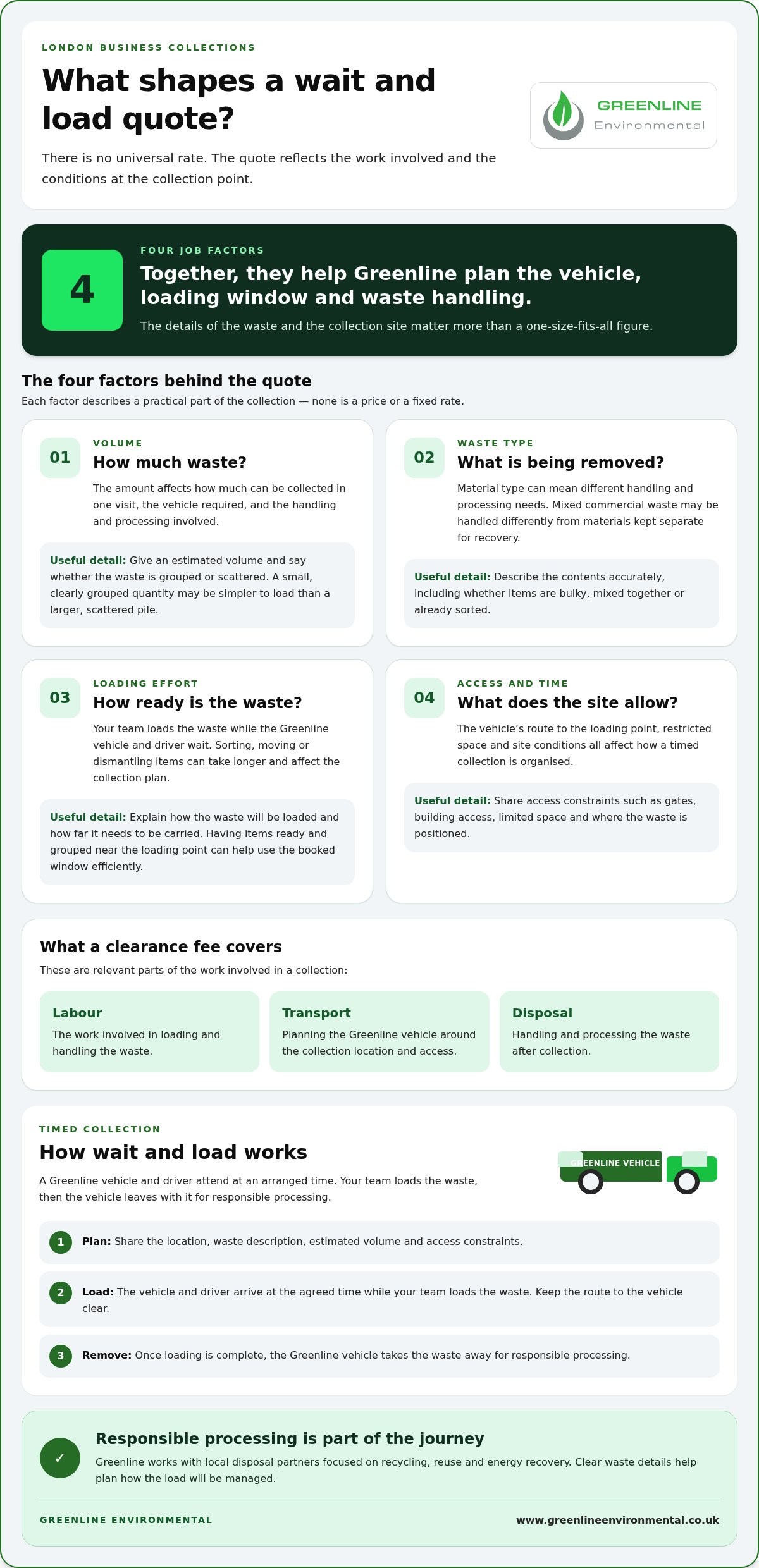
There isn’t one universal rate for every London collection. A tailored quote reflects the work involved: how much waste needs removing, what it consists of, how it will be loaded and what the collection point allows. Labour, transport and disposal are all relevant parts of a clearance fee, so accurate job details help Greenline plan the vehicle, loading window and waste handling.
In plain English, the quote depends on waste volume and type, loading effort, vehicle access and the time needed to complete the collection. These factors matter particularly in Central London, where limited space or difficult access can affect how a timed collection is organised.
How waste volume and material affect a quote
The amount of waste affects how much can be collected in one visit, the vehicle required and the work involved in handling and processing it. A small, clearly grouped quantity may be simpler to load than a larger, scattered pile. Material type matters too: mixed commercial waste can involve different handling and processing needs from materials kept separate for recovery.
Describe the contents as accurately as possible, including whether items are bulky, mixed together or already sorted. This helps Greenline plan the collection and responsible processing with local disposal partners, who focus on recycling, reuse and energy recovery. For general background on waste management regulations in the UK, see the overview of waste management practices and context.
Why loading time and site access matter
Consider whether the Greenline vehicle can reach the agreed loading point, how far waste must be carried, and whether gates, building access, restricted space or other site conditions could slow the work. In Central London, sharing these details in advance helps Greenline plan for the location rather than assume every collection has the same conditions.
The Greenline wait and load service is tailored to business requirements and site logistics. A clear description of the waste, its location and your loading arrangements gives the team a stronger basis for preparing a useful quote.
How does a London wait and load service work?
A wait and load collection follows a straightforward sequence for a shopfitting project: Greenline plans the job from the details you provide, sends a Greenline vehicle and driver to the agreed retail or commercial location, waits while your team loads the waste, then takes it away for responsible processing. The timed arrangement suits shopfitters who need to remove packaging, fixtures and other fit-out waste promptly, particularly where there is limited room to keep a skip in place. Collections are available 24 hours a day, seven days a week.
In restricted urban locations such as Central London, collecting waste directly into the Greenline vehicle can avoid the need for a skip permit. This can simplify planning where leaving a skip on site isn’t practical. Greenline arranges its wait and load service around the collection requirements and site logistics.
What happens before the vehicle arrives?
Start by sharing the collection location, a description of the waste, an estimated volume and any access constraints. Explain where the waste is positioned, how the Greenline vehicle can reach the loading point and whether there are practical restrictions such as limited space or controlled site access.
These details help Greenline plan the vehicle, loading arrangements and waste handling. Be as precise as you can: an estimate based on the actual pile or items is more useful than a broad description. For a London collection, route planning may also involve checking whether the vehicle’s journey is affected by London’s Congestion Charge; refer to Transport for London for current information.
What happens during loading and after collection?
At the arranged time, the Greenline vehicle and driver attend while your staff load the waste. Your team is responsible for loading, so prepare the waste beforehand and keep the route from its storage point to the vehicle clear. Grouping items near the loading area, where practical, can help your team make good use of the time on site.
Once loading is complete, the Greenline vehicle leaves with the waste. Greenline works with local disposal partners focused on recycling, reuse and energy recovery, making responsible processing part of the collection journey. The waste description also helps plan how the load will be managed as part of the wait and load service cost London quote.
To set out your business’s waste, volume and access details in one place, you can request a tailored wait and load quote.
Wait and load versus skip hire: which affects your London budget?
The better fit depends on when the waste is ready, how much space the site has and whether your team can load it during a planned vehicle visit. Wait and load uses a Greenline vehicle and driver for a timed collection, with your team loading the waste. Skip hire provides a container to fill over a period of time. Neither approach is automatically cheaper for every job, so compare the full requirements and access conditions before deciding.
Consider the wait and load service cost London quote alongside the practical demands of the site. A timed collection can suit waste that is ready to go, while a skip may suit a job where waste accumulates gradually. The choice also affects how long space is occupied and when staff need to handle the waste.
When a timed wait and load collection may fit
Wait and load can suit a restricted urban shopfitting site where keeping a skip in place is impractical, including some locations in Central London. The waste goes directly into the Greenline vehicle, so no container is left on site after collection. In such settings, this approach can avoid the need for a skip permit. Your team does need to be ready to load during the arranged visit, so it works best when the fit-out waste and loading route are prepared.
Explore the London wait and load business guide for more on how the service is arranged around business needs and site logistics.
When a skip-based approach may fit better
If waste will build up over time, a skip can provide a container on site for ongoing loading rather than requiring the team to have everything ready for one vehicle visit. This can suit work where materials arise in stages, provided there’s a practical place for the container and the site arrangements allow it. A wait and load collection, by contrast, concentrates loading into a planned window and removes the waste during that visit.
Consider available space, how waste will arise and who can load it. Skip arrangements may involve site or permit considerations depending on where the container is placed, so don’t assume the same conditions apply at every London location. For broader guidance on responsible handling, the Waste Duty of Care Code of Practice is an official reference for businesses managing waste.
Once you’ve identified the option that suits your site and work pattern, share those details through a request for a tailored quote.
How to prepare for an accurate wait and load quote
Good information makes it easier to scope the collection and plan around your site. Before requesting a quote, gather the practical details below. An inventory or photographs can also help show the type and amount of waste, particularly if the load includes bulky or mixed items.
- Collection location: Provide the full address and identify where the waste is situated on site.
- Waste description: List the main materials and note whether they’re mixed, separated or bulky.
- Estimated volume: Give a realistic estimate and explain how you arrived at it, such as the number of items or the approximate size of the pile.
- Access information: Describe the vehicle approach, loading point, distance the waste must be carried and any gates, restricted areas or other site constraints.
- Loading arrangements: Say whether the waste will be ready for your team to load and note any operational limits or preferred timing that could affect the job.
These details help Greenline plan the vehicle and loading arrangements for your business. If a photograph is useful, take it from a position that shows the scale of the waste and its location in relation to the loading point. Images support your description, but they don’t replace an accurate account of the materials, access and work involved.
Keep the job details current
The planned work may change if the waste volume is larger than estimated or the materials differ from the original description. Either could affect handling and processing. If the load changes before collection, share an updated description so the job can be planned around the actual waste.
For a clearer view of the wait and load service cost London businesses need to budget for, focus on accuracy rather than trying to make an estimate look smaller. Include relevant access restrictions and explain whether items are ready to load or still need organising. That gives Greenline a sound basis for tailoring the quote.
Once you’ve gathered the location, waste, volume and loading information, request a tailored wait and load quote for your London job.
Get a tailored wait and load quote for your London job
A useful quote reflects the actual shopfitting collection, not just a broad description of the waste. The contents and estimated volume help define the handling required, while access, loading arrangements and timing preferences shape how Greenline plans the vehicle and visit. Sharing the full picture gives your shopfitting business a clearer basis for planning the work and budget, including collections needed outside standard working hours.
What to include in your enquiry
Bring the key details together before you request a quote. Include the collection address, a description of the waste and a realistic estimate of its volume. Explain where it is stored, how the Greenline vehicle can reach the loading point, and whether staff need to move it through a building or across the site.
Also mention your preferred timing and any operational constraints that could affect loading, such as site access arrangements or limited room to work. If the waste or access details change, update the description so the collection plan reflects the job as it stands.
Choose a collection plan that suits the site
Wait and load can be a practical option for shopfitting jobs where waste is ready for direct loading and leaving a container on site isn’t suitable. It may be less appropriate if waste will accumulate gradually and needs to be stored in a container between fit-out stages. For larger shopfitting projects that produce waste in stages, Greenline’s bin hire may be a more suitable option than a single timed collection.
Greenline tailors its wait and load service to business requirements and London logistics. Collected waste is handled through local disposal partners focused on recycling, reuse and energy recovery, making responsible processing part of the plan. The right details at the outset help align the collection with your site and the waste involved.
Ready to plan your collection? Send Greenline your job details to request a tailored wait and load quote, including the location, waste description, estimated volume, access information and loading requirements. This gives the team a practical starting point for preparing a quote for the wait and load service cost London businesses need to budget for.
Plan your London collection with confidence
The wait and load service cost London businesses receive should reflect the waste, estimated volume, site access and loading requirements, not a one-size-fits-all rate. Sharing those details helps Greenline organise a timed collection suited to your business and the practical conditions at your site, whether it’s in EC1, EC2, EC3, EC4, WC1, WC2, E1, SE1, SW1, SW3, SW7 or SW8.
Greenline provides a vehicle and driver while your shopfitting team loads, with the wait and load service available 24 hours a day, seven days a week. This gives shopfitters greater flexibility when working around retail opening hours, delivery schedules, restricted access or urgent handover dates. After collection, local disposal partners focus on recycling, reuse and energy recovery, keeping responsible processing part of the plan.
Prepare your address, waste description, volume estimate and access or timing considerations, then request a tailored wait and load quote. Clear job details give you a practical starting point for an orderly collection that works for your London site.
Frequently Asked Questions
How much does a wait and load service cost in London?
Greenline prepares a tailored quote based on the work your shopfitting collection requires, rather than applying one universal rate. Waste type and volume, loading effort, vehicle access and time needed all help shape the job. Share a clear description of the fit-out load and site so the quote can reflect your requirements. With service available 24 hours a day, seven days a week, shopfitters can also discuss collection timing around their project schedule.
What affects the cost of a wait and load service?
The main factors are the amount and type of waste, how ready it is to load, and how easily the Greenline vehicle can reach the collection point. The distance from where the waste is stored to the loading area may also affect the work involved. Labour, transport and disposal are relevant components of clearance fees. An accurate estimate and details of site constraints help Greenline plan the vehicle and loading arrangements.
Is wait and load cheaper than hiring a skip?
Not in every situation. The right option depends on the job, available space, access and when the waste will be ready. Wait and load may suit a restricted site where the team can load waste during a planned vehicle visit. A skip may suit work that produces waste over time and needs a container on site. Compare the practical requirements as well as the tailored quote, rather than assuming one approach always costs less.
What information do I need to get a wait and load quote?
Provide the collection address, a description of the waste, a realistic estimate of its volume and details of vehicle access. Explain where the load is stored, how far it is from the loading point, whether it will be ready, and any timing preferences or site constraints. Photographs or an inventory can help illustrate the load. Accurate details allow Greenline to plan a quote around your business and collection arrangements.
Do I need a skip permit for wait and load in Central London?
A wait and load collection can avoid the need for a skip permit in restricted urban locations such as parts of Central London, because a Greenline vehicle attends for loading rather than leaving a skip on site. This can be useful where space is limited. Site conditions vary, so include the location and loading arrangements when planning the collection. Greenline tailors its timed vehicle-and-driver service to business requirements and London logistics.
How long does a wait and load collection take?
The loading period is arranged around the job, and the time required depends on the waste volume, how prepared it is and the route to the Greenline vehicle. A clear loading area and waste ready to move can help your team use the planned window effectively. Greenline provides the vehicle and driver while your staff load. Share access restrictions and loading considerations so the collection can be planned appropriately.
Can businesses use wait and load for construction waste?
Yes, Greenline provides wait and load for shopfitters and other businesses handling fit-out or construction waste. Include the types of material, estimated quantity, site access and loading arrangements in your job details. This helps plan the collection and handling, including a suitable collection time from the 24-hour, seven-day service. Greenline works with local disposal partners focused on recycling, reuse and energy recovery.