
A London recycling centre may accept old carpet as waste, but that does not mean it will recycle it. For office carpet disposal in London, acceptance rules vary, and the carpet’s condition, volume and whether it has already been lifted all matter.
That uncertainty can disrupt a shopfit or office refurbishment, especially when flooring needs to be cleared quickly. This guide explains how to find out whether a recycling centre can take the carpet, what to prepare for removal, and which details help organise a same-day commercial clearance request.
You’ll also learn how carpet tiles, underlay and site access affect the plan. These practical steps can help you choose a responsible disposal route and keep the project moving.
Key Takeaways
- Carpets may be accepted at London recycling centres as waste, but acceptance and recycling options vary by site. Find out how your local centre handles carpet tiles before transporting them.
- For a smoother uplift, separate or roll underlay and make gripper rods and tack strips safe by removing or securely bundling them with sharp points covered.
- When arranging same-day commercial carpet removal, share the amount of flooring, whether it has been lifted and the access arrangements so the collection can be planned around the site.
- Greenline Environmental’s Construction Waste Removal can support shopfitters clearing carpet and other construction waste as part of a refurbishment.
Can I take old carpet to a London recycling centre?
Some London recycling centres accept carpet as waste, but acceptance doesn’t mean recycling. Most UK household waste recycling centres accept carpets, although site rules vary.
Borough Rules and Waste Carriers
Borough requirements differ. In Westminster, carpet rolls shorter than 1.50 metres can go out for general waste if securely tied and each has a cardboard sticker. Fewer than 10 carpet tiles can also be presented this way. Commercial waste carriers handling bulky refurbishment waste collect carpet; council services may have different rules. For example, Westminster allows manageable carpet pieces in commercial waste bins.
Reuse, Recycling and Landfill Risks
Carpet tiles can be removed separately from broadloom carpet and assessed for reuse or recycling. Specialist facilities may separate fibres and backing, but the materials and any adhesive residue affect what can be recovered. Carpets are bulky, difficult to recycle and often made from non-biodegradable materials, so sending them to landfill can forgo reuse or recovery opportunities. Check the recycling centre’s acceptance rules for tiles and how it handles them.
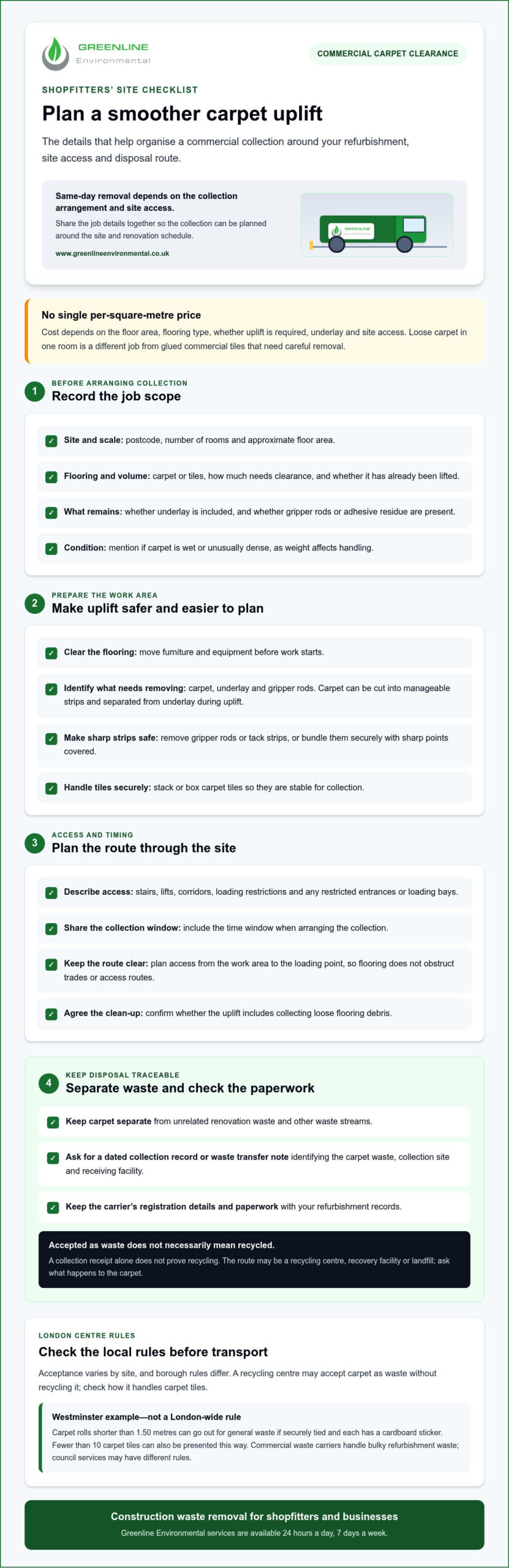
For an office collection, record the room count, tile volume and whether flooring has already been lifted. Stack or box tiles securely; describe adhesive residue, underlay and access through stairs, lifts or corridors. Keep gripper rods and sharp strips bundled safely. Share these details when arranging collection across London, so the carrier can plan loading and access.
Same-day removal depends on the collection arrangement and site access. Keep carpet separate from other waste streams; fire-safety equipment needs a separate fire extinguisher disposal route.
Same Day Carpet Removal Needed?
For same-day carpet removal, clear preparation helps the crew plan uplift, transport and disposal around your renovation schedule.
Removal Preparation and Site Clean-up
Before work starts, clear furniture and equipment from the flooring area. For larger premises, property clearance providers such as DLJ Property Solutions LLC can help clear out unwanted contents and debris before contractors arrive. Identify whether the carpet, underlay and gripper rods need removing, and bundle sharp rods or tack strips safely. During uplift, carpet can be cut into manageable strips and separated from the underlay. Agree what site clean-up includes, such as collecting loose flooring debris after removal.
Commercial Flooring Removal
Carpet from business premises is commercial waste. Flooring removed during a shopfit or renovation can be managed as part of the project’s construction waste. UK waste rules depend on the waste and its source, so keep carpet separate from unrelated materials. Stack tiles securely, and tell the collection service if adhesive residue is present or the tiles have already been lifted.
Carpet Removal Pricing
There is no single per-square-metre price for every London job. The cost depends on the floor area, flooring type, whether uplift is required, underlay and site access. Loose carpet in one room is a different job from glued commercial tiles that need careful removal. Describe the scope when requesting a quote to get a price based on the actual work.
Information for a Disposal Quote
For a clear quote, provide the site postcode, number of rooms, approximate floor area and flooring type. Explain whether carpet has been lifted, if underlay is included, and whether gripper rods or adhesive remain. Add access details, such as stairs, lifts, loading restrictions and the collection time window. For same-day requests, send these details together through the carpet removal quote form.
London office and commercial carpet uplift and disposal
For an office refit, plan carpet uplift alongside the wider clearance so flooring does not obstruct trades or access routes. The disposal route depends on the material, its condition and the receiving facility.
Commercial Carpet Uplift and Disposal
A removal service can collect rolled carpet, tiles and underlay from commercial premises. Tell the team whether flooring is already lifted, how much needs clearance and whether it is wet or unusually dense, since weight affects handling. Keep carpet separate from other renovation waste. A recycling centre may accept carpet as waste without recycling it; some north London loads may instead go to an energy-from-waste facility.
Proof of Legal Disposal
Ask for a dated collection record or waste transfer note that identifies the carpet waste, collection site and receiving facility. Request the carrier’s registration details and keep the paperwork with your refurbishment records. These documents help your business trace the disposal route, including whether carpet went to a recycling centre, recovery facility or landfill. A collection receipt alone does not prove that the carpet was recycled.
Council bulky-waste rules may apply to household collections. Commercial carpet from an office needs a collection plan suited to business waste and site access. Before booking, provide the postcode, carpet type, estimated volume and condition, along with loading arrangements. Mention restricted entrances or loading bays, and agree whether the uplift includes underlay and carpet tiles.
Wet carpet can be substantially heavier than dry flooring, so describe its condition before collection. For a commercial clearance, keep the route from work area to loading point clear, then request a written quote using the project details. Request a quote for carpet uplift to plan the collection and disposal route.
Greenline Environmental: Construction Waste Removal
Greenline Environmental provides Construction Waste Removal for shopfitters and businesses clearing flooring during a refurbishment. The service can manage carpet waste alongside other construction materials, helping keep the work area clear for the next project stage.
For an office refit, share the carpet quantity, whether it has already been lifted, and any access constraints. These details help shape a practical removal plan around the site and surrounding work. Greenline Environmental’s services are available 24 hours a day, 7 days a week, supporting businesses that need waste management to fit demanding schedules.
If carpet removal forms part of a wider office clear-out, Office Clearance may also suit the project. Contact Greenline Environmental to discuss your commercial waste requirements.
Plan the next stage of your fit-out
Make flooring removal part of your fit-out plan, not a last-minute obstacle. For office carpet disposal in London, align the uplift with the shopfit schedule and other materials leaving the site. A clearly defined collection scope helps keep the work sequence organised.
Greenline Environmental supports commercial projects with Construction Waste Removal, Office Clearance and rapid site clearance solutions. Choose the service that fits the job: carpet as part of refurbishment waste, a broader office clear-out, or materials that need removing from site. Include access details, flooring type and preferred timing in your request so the collection can be planned around the work programme.
Send your project details to discuss a suitable approach with Greenline Environmental. Request a quote for your carpet clearance, and take the next step towards a well-organised fit-out.
Frequently Asked Questions
Will the council collect old carpet?
Yes, many London councils offer bulky-waste collection for household carpets, but the rules and booking process vary by borough. Some services set limits on roll size or the amount collected per visit. For a commercial premises in EC1 or SE1, household collection rules may not apply, so arrange disposal as business waste rather than assuming the council service covers it.
Do I need to separate carpet and underlay?
Separating carpet and underlay is not always essential, but it helps the collection team assess the load and handling. If the underlay is easy to remove, bag or roll it separately and identify whether it is foam, felt or rubber. Keep carpet tiles apart from broadloom carpet, especially when adhesive residue remains, so each material can be assessed appropriately.
How does carpet disposal work in London?
Choose a route based on whether the carpet comes from a home or a business. Household carpet can go through a council bulky-waste service or a reuse and recycling centre, subject to local rules. For an office in EC2 or WC2, organise commercial collection and provide the site location, flooring type and access details so the waste can be directed appropriately.
How should carpet be prepared?
Keep carpet dry, roll it tightly and secure each roll for easier loading. Cut long sections into shorter lengths if needed to fit stairs, corridors or the vehicle entrance. Remove loose blades, and bundle gripper rods with their sharp points covered. Store underlay separately if possible, and keep prepared material clear of walkways.
How much does office carpet disposal cost in London?
Commercial carpet disposal costs depend on the amount and weight of flooring, whether uplift is required, site access, labour, transport and disposal route. Glued tiles or heavy underlay can involve more work than loose, rolled carpet. For a useful estimate, provide the floor area, material type, condition and collection address when requesting a quote.