
The key check is an active upper-tier waste carrier registration, not just a promise that waste will be handled properly. For commercial collections in London, how to choose a licensed waste carrier in London comes down to confirming the registration is current and matches the business collecting your waste. Ask for a Waste Transfer Note at collection to record the transfer.
You should be able to arrange a straightforward collection, but your business remains responsible for taking reasonable steps to ensure its waste goes to someone authorised to receive it. This guide explains what waste carrier registration means, which documents to keep, how commercial duty of care applies and how to assess carriers in London. It also explains why the registered business name matters, so you can keep a clear record of who collected the waste and how the transfer was documented.
Key Takeaways
- Confirm the carrier’s registration is active and that its registered business name matches the business invoicing you.
- Ask for a Waste Transfer Note when your commercial waste is collected, then keep the transfer record on file.
- Your business has a duty of care to take reasonable steps to ensure its waste goes to someone authorised to take it.
- Use the Environment Agency’s public register to find and check waste carrier registrations in London.
What should a registered carrier hand me at collection?
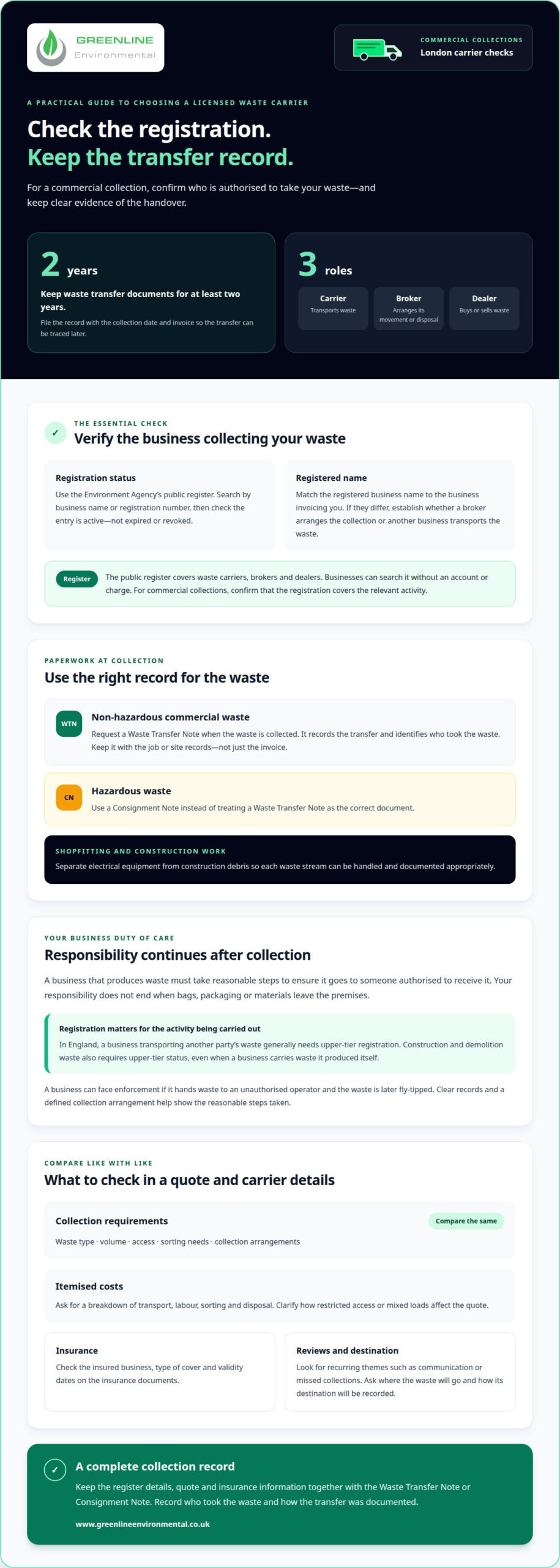
At collection, request a Waste Transfer Note (WTN) for non-hazardous commercial waste. It records the transfer and identifies who took the waste. File it with the job or site records, not just the invoice. This gives your business a clear record if questions arise later.
According to the Department for Environment, Food & Rural Affairs, keep waste transfer documents for at least two years. Store the WTN beside the collection date and invoice, so the transfer can be traced later. For hazardous waste, use a Consignment Note instead of treating a WTN as the correct document.
The National Archives identifies operating as a waste carrier without a valid licence as a criminal offence under the Environmental Protection Act 1990. In England, a business transporting another party’s waste needs upper-tier waste carrier registration. Registration covers carriers, brokers and dealers, but each role involves different activity. A carrier transports waste; a broker arranges its movement or disposal.
To compare London waste carrier quotes and avoid unexpected charges, compare offers for the same waste type, volume, access and collection arrangements. Ask for an itemised breakdown, including transport, labour, sorting and disposal, and clarify how restricted access or mixed loads affect the quote.
A council collection follows the relevant London borough’s service arrangements; a private carrier is contracted directly by your business. Commercial duty of care still applies when your business produces waste, whichever collection route you use.
Before collection, match the paperwork to the service. Keep the WTN or Consignment Note with your business records, and retain it for the required period. If the carrier’s role is unclear, confirm whether it transports the waste itself or arranges for another party to take it.
Business duty of care for commercial waste
A London business that produces waste has a duty of care under the Environmental Protection Act. It must take reasonable steps to ensure the waste goes to someone authorised to receive it. Responsibility doesn’t end when bags, packaging or materials leave the premises. Your business should understand who takes the waste and how it will be managed.
In England, registration is required for businesses that transport, buy or sell, or dispose of waste, as well as those that arrange for someone else to do so. A business carrying another organisation’s waste generally needs upper-tier registration. Construction and demolition waste also requires upper-tier status, even when a business carries waste it produced itself. Lower tier applies only to specified activities, such as carrying waste produced by the same business, subject to that construction exception.
Anyone arranging waste movements should understand their role. Carriers transport waste; brokers arrange for another party to transport, recover or dispose of it; dealers buy or sell waste. A business can face enforcement if it hands waste to an unauthorised operator and the waste is later fly-tipped. Clear records and a defined collection arrangement help show the reasonable steps taken.
Finding licensed carriers in London
To choose a licensed waste carrier in London, start with the Environment Agency’s public register. Search by business name or registration number, then check that the entry is active and not expired or revoked. The register includes waste carriers, brokers and dealers, and businesses can search it without an account or charge.
For commercial collections, check that the registration covers the relevant activity. A business transporting someone else’s waste for payment generally needs upper-tier registration. Match the registered name to the business invoicing for the collection. If the names differ, establish whether a broker arranges transport or another business collects the waste.
The cost of a licensed waste carrier in London depends on the waste type, volume, access, sorting needs, transport and disposal arrangements. Compare quotes for the same materials and collection requirements, and look for an itemised breakdown of potential extra charges.
To assess a carrier’s insurance, reviews and waste disposal arrangements, check the insured business, type of cover and validity dates on its insurance documents. Look for recurring themes in reviews, such as communication or missed collections. Ask where the waste will go and how its destination will be recorded.
To make how to choose a licensed waste carrier in London a practical decision, keep the register details, quote and insurance information together with the collection record. For a London collection, request a quote for your waste collection, including the waste type, estimated volume and site access details.
Greenline Environmental: Construction Waste Removal
Greenline Environmental provides Construction Waste Removal for businesses managing building work, refurbishments and shopfitting projects. Services are available 24 hours a day, 7 days a week, supporting businesses working around demanding site schedules.
For shopfitters, outline the materials involved, where they are located and any access restrictions when planning a collection. This helps tailor arrangements to the work taking place. Keep the waste transfer documentation with your business records after collection.
Greenline Environmental also provides Event Waste Management and Confidential Waste Shredding for these specific business needs. For construction waste removal at your site, contact Greenline Environmental to discuss the collection.
Make your next collection easier to plan
Choosing a licensed waste carrier in London is also an opportunity to build waste handling into site planning rather than leave it until the last minute. For shopfitters and businesses preparing a refurbishment, identify the waste streams and collection needs early. This gives you a clearer basis for planning around site access and operational demands.
Greenline Environmental provides Construction Waste Removal, rapid rubbish collections and Office Clearance for business requirements. When describing your job, set out the materials involved, where they are located and any access considerations. This helps shape a collection plan around the work taking place.
If you’re planning a collection or clearance, contact Greenline Environmental to discuss your requirements. A considered plan can help keep your site organised and your next steps clear.
Frequently Asked Questions
What is a Waste Carrier Licence?
A Waste Carrier Licence is the common term for registration with the Environment Agency as a waste carrier, broker or dealer. In England, registration records the business and the activities it is authorised to carry out. For example, a firm transporting waste from a shop refurbishment needs registration appropriate to carrying another business’s waste, not merely a record of its own waste.
Does my collector need upper tier or lower tier?
A collector transporting waste produced by another business generally needs upper-tier registration. Lower tier can apply when a business carries only waste it produced itself, but not when that waste is construction or demolition waste. For a shop refurbishment in EC1 or SE1, construction waste therefore points to upper-tier registration, even if the contractor generated it.
What happens if you don’t have a licence?
If registration is required, operating without a valid one can lead to criminal consequences. The National Archives identifies operating as a waste carrier without a valid licence as a criminal offence under the Environmental Protection Act 1990. A business that arranges collection should also consider the risk of waste being mishandled or fly-tipped, which can bring scrutiny to the producer.
Who can legally transport commercial waste in London?
A registered carrier with the correct tier for its activity can transport commercial waste in London. A business moving another organisation’s waste needs upper-tier registration; one carrying only its own qualifying waste may fall under lower tier. Registrations held in Scotland or Wales also authorise businesses to operate in England, including Central London.
How to check whether a waste carrier is registered with the Environment Agency?
Use the Environment Agency’s public register and search by the carrier’s business name or registration number. Confirm the entry is active and matches the business responsible for the collection. For a collection in WC2 or E1, compare the registered name with the name on the invoice; a different name may indicate a broker or another business is involved.